
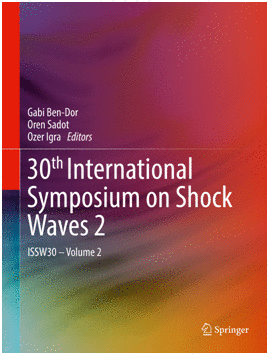
BEN-DOR, G.; SADOT, O.; IGRA, O.
Descuento:
-5%Antes:
Despues:
394,25 €1. Studies of Shock Wave Reflections and Interactions (Paul Vieille Lecture)
2. Dispelling Misconceptions about Bast Waves (Irvine Israel Glass Lecture)
3. A Review of the Richtmyer-Meshkov Instability from an Experimental Perspective
4. Medical and Biomedical Applications of Shock Waves: The State of the Art and the Near Future
5. Making Shock Waves Pay: The Commercial Aspects of Shock Waves
6. Time-Developing 3D-CT Measurement of Shock Waves and Supersonic Density Flow Field
7. Chemical Kinetics and Reacting Flows
8. Shock-Induced Combustion and Its Applications to Power and Thrust Generation
9. The Shock Fitting Technique from Gino Moretti Towards the Future
10. New Modified Pekkari Model to Analyse the Aeroelastic Stability Behaviour for a Flexible Overexpanded Rocket Nozzle
11. Adaptation of the Transpiration Method to Simulate the Fluid–Structure Interaction Phenomena for a Flexible Overexpanded Rocket Nozzle
12. Transverse Jet Injection into a Supersonic Nozzle Flow
13. Flow Visualization in Out-of-Round Rocket Nozzles
14. Effect of the Adiabatic Index on the Shock Reflection in Overexpanded Nozzle Flow
15. Mixing Enhancement in Free Jets from Supersonic ESTS Lobed Nozzles
16. Study of Cluster Linear Plug Nozzle Flow Field in Freestream Flow
17. Studies in Free Jets from Supersonic ESTS Lobed Nozzles
18. Unsteadiness of Supersonic Flows in Over-Expanded Nozzles
19. Design of Optimized Two-Dimensional Scramjet Nozzle Contour for Hypersonic Vehicle Using Evolutionary Algorithms
20. Passive Flow Control in Laval Nozzles Due to Bypass Mass Flow in Narrow Longitudinal Gaps
21. Investigation of Chemical Non-equilibrium Hypersonic Flows in Carbon Dioxide–Nitrogen Atmospheres Using a Coupled Euler–Boundary-Layer Method
22. Radiative Heat flux Measurements for Titan Atmospheric Entry Condition in a Superorbital Expansion Tunnel
23. Study of Hypersonic Dissociating Flows over Spheres Using the Space-Time CE/SE Method
24. The Direct Measurement of Skin Friction in Shock Tunnel
25. Effects of Attack Angle on Starting Performance of a Hypersonic Inlet
26. Optimization of Hypersonic Power Law Derived Waverider Using TLBO
27. Experimental Analysis of Shock Standoff Distance in Hypersonic Flows over Spherical Bodies
28. Oscillatory Behaviors of a Hypersonic Inlet with Trips
29. Aerodynamic Force and Moment Measurement Under Duplicated Hypersonic Flight Conditions in the JF12 Shock Tunnel
30. A Method of Detecting Self-Starting Ability of Hypersonic Inlets: A Numerical Investigation
31. Experimental Investigation on the Self-Starting Characteristics of Hypersonic Inlets
32. An Investigation of Type IV Shock Interaction Over a Blunt Body with Forward-Facing Cavity
33. Particularities of the Shock Wave Propagation Through the Region of Gas Discharge Plasma
34. Numerical Research of Supersonic Mixing in Conditions of Localized Pulse-Periodic Energy Supply Upstream of Tandem Shock and Expansion Waves
35. Effect of Differential Sweep on a Three-Dimensional Sidewall-Type Intake at Mach 3.5
36. Experimental Study of Dynamic Characteristics of Oblique Shock Trains in Mach 5 Flow
37. Aero-Optical Measurement in Shock Wave of Hypersonic Flow Field
38. Super-/Hypersonic Aero-Optical Effects Induced by External Jet Cooling
39. Thermal Analysis of Scramjet Combustor Panel with Active Cooling Using Cellular Materials
40. A Methodology for Coupled Thermal-Structural Analysis and Structural Design of Scramjet Combustor
41. Thermomechanical Deformation Behavior of a Hypersonic Waverider Using Finite Element Method
42. Effect of Mach Number on Shock Oscillations in Supersonic Diffusers
43. Turbulence Compressibility Effects for Supersonic and Hypersonic Separated Flows
44. Imaging of the Conical Kelvin-Helmholtz Instability
45. Shock Standoff Distance over Spheres in Unsteady Flows
46. The Formation of Mach Waves from Supersonic Jets with Outer Co-flowing
47. The Limits of Mach Wave Emission from Supersonic Jets
48. Overexpanded Jet Flow Theoretical Analysis in the Vicinity of the Nozzle Lip
49. Design and Validation of an Uncooled Pitot Probe for Hot, Supersonic Flow Investigations
50. Large Eddy Simulation of a Supersonic Underexpanded Square Jet
51. Species Time-History Measurements During Jet Fuel Pyrolysis
52. Rapid Chemiluminescent Imaging Behind Reflected Shock Waves
53. Shock Tube Experimental and Theoretical Study on the Thermal Decomposition of 2-Phenylethanol
54. Soot Formation During Pyrolysis and Oxidation of Aliphatic and Aromatic Hydrocarbons in Shock Waves: Experiments and Detailed Kinetic Modeling
55. 3-Carene Oxidation Mechanism
56. Shock Tube Ignition Delay Studies of Dicyclopentadiene
57. Model Order Reduction for Reacting Flows: Laminar Gaussian Flame Applications
58. Numerical Simulation of the Flow with Chemical Reactions Around a Wedge
59. Computations of a Shock Layer Flow Field with Global and Detailed Chemistry Models
60. On a Relaxation Zone Structure for Shock Waves Forming in Non-equilibrium Air Flows
61. Investigation of Non-catalytic Reaction of Shock-Heated Nitrogen Gas with Powder SiO2
62. On the Deflagration-to-Detonation Transition in Narrow Tube with Varying Prechamber-Initiator
63. Experimental Research on Deflagration-to-Detonation Transition (DDT) in an S-Shaped Tube
64. DDT Triggered by SWBLI: Numerical and Experimental Research
65. Flame Acceleration and DDT in a Torus Geometry
66. Unconfined Hybrid Detonation in Gas–Particle Flow
67. Numerical Simulation of Combustion Process for Two-Phase Fuel Flows Related to Pulse Detonation Engines
68. Simulation of Laser-Induced Detonation in Particulate Systems with Applications to Pulse Detonation Engines
69. Criterion for Detonation Transition in Liquid-Fuel Pulse Detonation Engines
70. Numerical Simulation of Reactive Gas Mixes Flows in the Detonation Engines
71. Stabilization of Detonation Combustion of a Supersonic Flow due to Using the Special Form Plane Channel
72. Role of Wall Temperature on Shock Train in a Rectangular Isolator
73. The Correlation Between Detonation Cell Size and Ignition Delay Time
74. An Investigation of the Prompt Oblique Detonation Wave Induced by a Finite-Length Wedge
75. Formation of 3D Detonation in Supersonic Flows by Solid Walls of Special Shape
76. Cellular and Spin Detonation in 3D Channels
77. Galloping Detonation in a Fuel Mixture Jet
78. Propagation of Out Warding Flame for Combustible Gas in Cylindrical Confinement
79. Investigation on PIV and PLIF Laser Diagnostics in Turbulent Combustion Field
80. Modeling of Aerobic Combustion
81. Investigations of Equivalence Ratio on Operational Liquid-Fuel Pulse Detonation Engines
82. Detonation of Mechanoactivated Mixture of Ammonium Perchlorate with Aluminum
83. Detonation Transition in Relatively Short Tubes
84. Propagation of a Pressure-Dependent Detonation with Different Acoustic Impedance Confinements
85. Kerosene Ignition and Combustion: An Experimental Study
86. On Influence of Carbon Tetrachloride on Combustible Mixtures Ignition at Various Temperature Ranges
87. Temperature Measurements in the Combustion Zone Behind the Reflected Shock Waves
88. On the Initiation of Combustion by Means of Supersonic High-Enthalpy Jet
89. A Test of Ignition Behaviors Induced by a Smoothly Convergent Cylindrical Shock
90. Nonstationary Interaction of Incoming Flow with Ablative Jet in Supersonic Laser Propulsion
91. Axisymmetric Compressible Flow for the Resistojet Thruster Module
92. Secondary Injectant Gas Thermodynamic Properties Effects on Fluidic Thrust Vectoring Performances of a Supersonic Nozzle
93. Three-Dimensional Bow-Shock Interactions Between High-Speed Slender Bodies at Incidence
94. Flow Behind Mach Reflection and the Neumann Paradox
95. The Mach Reflection of a Converging Cylindrical Shock Wave Segment Encountering a Straight Wedge
96. Reflection of Cylindrical Converging Shock Wave Over Wedge
97. Numerical Study of the Interaction Process Between a Planar Shock Wave and a Square Cavity Filled with Different Gases
98. Flow Phenomena of An Expansion Wave Entering a Cylindrical Cavity
99. Investigation of an Expansion Fan/Shock Wave Interaction Between Low Aspect Ratio Wedges
100. Studying Shock Wave Reflections over Double Cylindrical Concave Wedge Reflectors
101. High Resolution Experimental Investigation of the Reflection Over a Convex-Concave Cylindrical Model
102. Characteristic Properties of the Formation of Shock-Wave Reflection Configurations in Unsteady Flows
103. Analytical Approach to the Problem of Three-Dimensional Steady Shock Wave Interactions
104. The Effect of Acoustic Impedance of Reflecting Surface on Oblique Shock Reflection
105. Experimental Investigation of Normal Shock Wave-Counter Flow Interactions
106. Shock Wave Reflection Over Roughened Wedges
107. Surface Oxidation Study of ZrB2–SiC Composite for Re-entry Applications Using Free Piston-Driven Shock Tube
108. Shock Wave Reflections Over Newtonian and Non-Newtonian Wedges: Experimental Investigation
109. Ground Effect of Transonic and Supersonic Projectiles: Influence of Mach Number and Ground Clearance
110. The Influence of Concave Wedge Tips on Shock Reflection Patterns
111. Shock Tunnel Studies on Shock–Shock Interaction
112. A Study on Unsteady Shear Layer–Shock Interaction in a Vacuum Ejector-Diffuser System
113. The Compressible Shear Layer of a Mach Reflection
114. Experimental Study of Mach Reflection in Cellular Detonation of C2H2–O2–8.17Ar
115. The Existence of a Consistent Stationary Mach Reflection in Shock Tube Flows
116. Analysis of Wide-Driver Shock Tube Flow with Sharp Area Transition
117. Shock Waves Initiated by Optical Pulsing Discharge in the Supersonic Air Flow
118. Stationary Regular Reflection: Viscous and Rarefaction Effects
119. Simplified Models of Shock Waves Interaction with Rigid and Flexible Obstacles
120. Blast Wave Impact on a Parallelepiped Headed with a Semicylindrical Model Drilled with a Rectangular Cavity
121. A Comparison of Numerical and Experimental Results of Passive Shock Wave Mitigation Using Obstacles in Two-Dimensional Channels
122. Mitigation of Weak Shock Waves: Its Applications to Design of Automobile Engine Silencers and Mufflers
123. A New Method to Assess Mitigation Efficiency of a Protective Barrier Against the Effects of a Vapor Cloud Explosion
124. Numerical and Experimental Analysis of the Effect of Different Shapes of Rigid Barriers on Blast Wave Propagation
125. Study on the Effects of Granular Particles on High Speed Gas Flow using DSMC Method
126. Model of Shock Wave Action on Porous Materials and Mixtures
127. The Collapsing Mechanism of Aluminum Foams
128. Study on the Jet Formation During Dispersal of Solid Particles by Shock and Blast Waves
129. Response of Embedded Pipeline to Surface Blast Loading
130. Dense Particle Cloud Deflection During Shock Interaction
131. Shock Mitigation by Dust Lofting: Theoretical Perspective
132. Dust Lofting Behind a Shock Wave
133. Shock Ignition of Reactive Particles
These proceedings collect the papers presented at the 30th International Symposium on Shock Waves (ISSW30), which was held in Tel-Aviv Israel from July 19 to July 24, 2015. The Symposium was organized by Ortra Ltd. The ISSW30 focused on the state of knowledge of the following areas: Nozzle Flow, Supersonic and Hypersonic Flows with Shocks, Supersonic Jets, Chemical Kinetics, Chemical Reacting Flows, Detonation, Combustion, Ignition, Shock Wave Reflection and Interaction, Shock Wave Interaction with Obstacles, Shock Wave Interaction with Porous Media, Shock Wave Interaction with Granular Media, Shock Wave Interaction with Dusty Media, Plasma, Magnetohyrdrodynamics, Re-entry to Earth Atmosphere, Shock Waves in Rarefied Gases, Shock Waves in Condensed Matter (Solids and Liquids), Shock Waves in Dense Gases, Shock Wave Focusing, Richtmyer-Meshkov Instability, Shock Boundary Layer Interaction, Multiphase Flow, Blast Waves, Facilities, Flow Visualization, and Numerical Methods. The two volumes serve as a reference for the participants of the ISSW30 and anyone interested in these fields.
 -5%
-5%
 -5%
-5%
 -5%
-5%
 -5%
-5%
 -5%
-5%
 -5%
-5%
 -5%
-5%
 -5%
-5%
 -5%
-5%
 -5%
-5%
 -5%
-5%