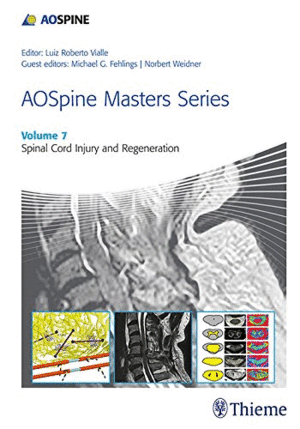
VIALLE, L.; WEIDNER, N.; FEHLINGS, M.
Descuento:
-5%Antes:
Despues:
108,67 €1. Pathobiology of Spinal Cord Injury 1
2. Assessment of Functional Status and Outcomes of Individuals with Traumatic Spinal Cord Injury 11
3. Serum and CSF Biomarkers to Predict Functional Recovery After Spinal Cord Injury 25
4. Magnetic Resonance Imaging of the Injured Spinal Cord: The Present and the Future 39
5. Acute Nonoperative Management of Traumatic Spinal Cord Injury: State of the Art 57
6. Role and Timing of Surgery for Traumatic Spinal Cord Injury: What Do We Know and What Should We Do? 71
7. Methylprednisolone As a Valid Option for Acute Spinal Cord Injury: A Reassessment of the Literature 80
8. Neuroprotection of the Injured Spinal Cord: What Does the Future Hold? 89
9. Hydrogel Biomaterials in Spinal Cord Repair and Regeneration 107
10. Neural Stem Cell Transplantation for Spinal Cord Repair 122
11. Strategies to Overcome the Inhibitory Environment of the Spinal Cord 132
12. Functional Electrical Stimulation and Neuromodulation Approaches to Enhance Recovery After Spinal Cord Injury 148
13. Advanced Rehabilitation Strategies for Individuals with Traumatic Spinal Cord Injury 163
14. Brainâ Computer Interfaces to Enhance Function After Spinal Cord Injury 179
World-renowned experts share the latest updates in translational research as well as surgical and nonsurgical strategies for treating spinal cord injury. Spinal cord injury (SCI) is a devastating, clinically challenging injury, leading to varying degrees of neurological function impairment and paralysis. Underlying biological mechanisms either inhibit or promote new growth in the spinal cord. Researchers have been making important discoveries about how neurons and their axons grow in the central nervous system and why they fail to regenerate after SCI. Although progress has been steady, there remains an urgent need to address issues in acute management such as early decompression and the use of biologics, as well as potential solutions for regeneration.
Features
• This volume in the AOSpine Masters Series focuses on state of the art of spine injury and regeneration, presenting the pathobiology of spine injury, assessment and diagnostic considerations, and operative, non-operative, and use of biologics, and covers rehabilitation.
• The AOSpine Masters series, a co-publication of Thieme and the AOSpine Foundation, addresses current clinical issues featuring international masters sharing their expertise in the core areas in the field.
Authors
• Luiz Vialle. Orthopedics, School of Medicine Catholic University of Parana State. Curitiba, Brazil
• Michael Fehlings. McEwen Centre for Regenerative Medicine Toronto Western Hospital University Health Network. Division of Neurosurgery Department of Surgery University of Toronto. Toronto, Ontario, Canada
• Norbert Weidner. Spinal Cord Injury Center Heidelberg University Hospital. Heidelberg, Germany
 -5%
-5%
 -5%
-5%
 -5%
-5%
 -5%
-5%
 -5%
-5%
 -5%
-5%
 -5%
-5%
 -5%
-5%
 -5%
-5%
 -5%
-5%