Descuento:
-5%Antes:
Despues:
266,76 €Preface
Chapter 1. Neural Control of Muscle
Chapter 2. New Advances in Single Fiber Electromyography
Chapter 3. Detection and Conditioning of EMG
Chapter 4. An Introduction to EMG Signal Processing Using MatLab and Microsoft Excel
Chapter 5. Modeling the Human Elbow Joint Dynamics from Surface Electromyography
Chapter 6. Arm Swing during Human Gait Studied by EMG of Upper Limb Muscles
Chapter 7. Using in Vivo Subject-Specific Musculotendon Parameters to Investigate Voluntary Movement Changes after Stroke: An EMG-Driven Model of Elbow Joint.
Chapter 8. Study and Interpretation of Neuromuscular Patterns in Golf
Chapter 9. Assessing Joint Stability from Eigenvalues Obtained from Multi-Channel EMG: A Spine Example
Chapter 10. Endurance Time Prediction using Electromyography
Chapter 11. EMG Activation Pattern during Voluntary Bending and Donning Safety Shoes
Chapter 12. Tongue Movement Estimation Based on Suprahyoid Muscle Activity
Chapter 13. Design of Myocontrolled Neuroprosthesis: Tricks and Pitfalls
Chapter 14. Design and Development of EMG Conditioning System and Hand Gesture Recognition Based on Principal Component Analysis Feature Reduction Technique
Chapter 15. The Relationship between Anthropometric Variables and Features of Electromyography Signal for Human–Computer Interface
About the Contributors
Index
Electromyography (EMG) is a procedure for assessing and recording the electrical activity produced by skeletal muscles. Since the contracting skeletal muscles are greatly responsible for loading the bones and joints, information about the muscle EMG is important to gain knowledge about muscular-skeletal biomechanics.
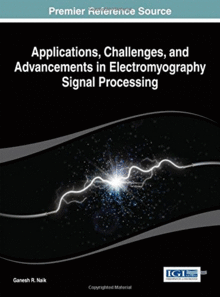
Applications, Challenges, and Advancements in Electromyography Signal Processing provides an updated overview of signal processing applications and recent developments in EMG from a number of diverse aspects and various applications in clinical and experimental research. Presenting new results, concepts, and further developments in the field of EMG signal processing, this publication is an ideal resource for graduate and post-graduate students, academicians, engineers, and scientists in the fields of signal processing and biomedical engineering.
• Applications in Electromyography (EMG)
• Electromyography Signal Processing
• Gesture Recognition
• Joint Biometrics
• Motion Analysis
• Muscle Fatigue
• Source Localization
Author
Ganesh R. Naik received B.E. degree in Electronics and Communication Engineering from the University of Mysore, India, in 1997. He received his M.E. degree in Communication and Information Engineering from Griffith University, Brisbane, Australia, in 2002, and the PhD degree in the area of Electronics Engineering, specialised in Biomedical Engineering and Signal processing from RMIT University, Melbourne, Australia, in 2009. He is currently Chancellor's Post Doctoral Research Fellow at Faculty of Engineering and Information Technology (FEIT), UTS. As an early career researcher, he has edited 9 books, authored more than 80 papers in peer reviewed journals, conferences, and book chapters over the last five years. His research interests include EMG signal processing, Pattern recognition, Blind Source Separation (BSS) techniques, Biomedical signal processing, Human Computer Interface (HCI) and Audio signal processing. Currently he serves as an associate editor for two Springer journals (Circuits, Systems, and Signal Processing and Australasian Physical & Engineering Sciences in Medicine). He is also a reviewer and member of editorial board in several reputed journals. He is a recipient of the Baden–Württemberg Scholarship from the University of Berufsakademie, Stuttgart, Germany (2006–2007). In 2010, Dr. Naik is awarded with ISSI overseas fellowship from skilled Institute Victoria, Australia.
 -5%
-5%
 -5%
-5%
 -5%
-5%
 -5%
-5%
 -5%
-5%
 -5%
-5%
 -5%
-5%
 -5%
-5%
 -5%
-5%
 -5%
-5%