Descuento:
-5%Antes:
Despues:
209,00 €Chapter 01: Water, Acids and Bases
1.1. Solubility
1.2. Hydrogen Bonding
1.3 Cellular Systems
1.4. Acid-Base Equilibria in Water
1.5. Buffers
1.6. Structural Features That Influence Acid Strength
1.7. Acid-Base Equilibria of Amino Acids
1.8. Acid-base reactions in Biological Systems
1.9. Acid and Base Character of Alcohols, Thiols, Amines and Carbonyls
1.9.A. Acids
1.9.B. Bases
1.10. Directionality
HOMEWORK
Chapter 02: Amino Acids
2.1 Characteristics of Amino Acids
2.2. Structure of ?-Amino Acids
2.3. Biosynthesis of Amino Acids
2.4. Reactions and Synthesis of ?-Amino Acids
HOMEWORK
Chapter 03: Peptides and Proteins
3.1. Peptides Are Poly(amides) of Amino Acid Residues
3.2. Peptide Biosynthesis
3.3. Chemical Synthesis of Peptides
3.4. Proteins and Enzymes Are Poly(peptides)
3.5. Peptidases
3.6. Peptide Degradation and End Group Identification
HOMEWORK
Chapter 04: Enzymes
4.1. Kinetics
4.1.A. Kinetics in Organic Chemistry
4.1.B. Catalysts and Catalytic Reactions
4.1.C. Enzyme Kinetics
4.2. Enzymes and Enzyme Classes
4.3. Oxidoreductases (EC 1)
4.3.A. Oxidases
4.3.B Chemical Oxidation of Alcohols
4.3.C. Reductases
4.3.D. Chemical Reduction of Carbonyl Compounds
4.4. Transferases (EC 2)
4.4.A. Methyl, Hydroxyl, Thiol, and Glycosyl Transferases
4.4.B. Chemical Reactions That Incorporate Methyl, Hydroxyl, Glycosyl
or Amino Groups into New Molecules
4.5. Hydrolyases (EC 3)
4.5.A Esterases
4.5.B. Other Hydrolyases
4.5.C Chemical Hydrolysis
4.6. Lyases (EC 4)
4.6.A. Lyase Reactions
4.6.B. Bond Cleavage in Organic Chemistry
4.6.B.1. Decarboxylation
4.6.B.2. Enol Formation and the Acid-Catalyzed Aldol
4.6.B.3. Elimination and Dehydration Reactions
4.7. Isomerases (EC 5)
4.7.A. Isomerase Reactions
4.7.B. Chemical Isomerization Reactions
4.8. Ligases (EC 6)
4.8.A. Enzymatic Coupling
4.8.B. Synthesis of Polynucleotides and Polynucleosides
4.8.C. Chemical Methods for Carboxylation and Nucleotide Synthesis
4.9. Translocases (EC 7)
4.9.A. Enzymatic Transport Reactions
4.9.B. Transport of Organic Materials
HOMEWORK
Chapter 05: A Review of Organic Chemistry
5.1. Bonding and Orbitals
5.2. Ionic versus Covalent Chemical Bonds
5.3. Breaking Covalent Bonds
5.4. Polarized Covalent ?-Bonds
5.5. Reactive Intermediates
5.6. Alkanes and Isomers
5.7. The IUPAC Rules of Nomenclature
5.8. Rings Made of Carbon: Cyclic Compounds
5.9. Hydrocarbon Functional Groups with p-Bonds
5.10. Heteroatom Functional Groups
5.10.A. C—X Type Functional Groups
5.10.B. C=X Type Functional Groups
5.11. Non-Covalent Bonding and Solubility
5.12. Rotamers and Conformation
5.13. Conformations of Molecules With Functional Groups
5.14. Conformation of Cyclic Molecules
5.15. Stereogenic Carbons and Stereoisomers
5.16. Absolute Configuration. The (R) and (S) Nomenclature
5.17. Specific Rotation
5.18. Diastereomers
5.19. Alkene Stereoisomers: (E) and (Z)-Isomers
HOMEWORK
Chapter 6: Nucleophilic Substitution and Elimination Reactions
6.1. Enzymatic SN2 Reactions
6.2. Nucleophiles and Bimolecular Substitution in Organic Chemistry (the SN2 Reaction)
6.3. Biological SN1-Type Processes
6.4. Carbocations and SN1 Reactions in Organic Chemistry
6.5. Ethers and Thioethers as Nucleophiles in Substitution Reactions
6.6. Biochemical Reactions of Ketones and Aldehydes
6.7. Enzymatic Acyl Substitution Reactions
6.8. Chemical Reactions of Carbonyl Groups in Organic Chemistry
6.9. Carboxylic Acid Derivatives and Acyl Substitution
6.10. Elimination Reactions of Alkyl Halides (E2 and E1 Reactions)
HOMEWORK
Chapter 7: Dienes and Conjugated Carbonyl Compounds in Biochemistry
7.1. Enzyme Mediated Conjugate Additions
7.2. Conjugated Dienes and Conjugated Carbonyl Compounds
7.3. Reactions of Conjugated Compounds
7.4. Conjugate (Michael) Addition
7.5. Cycloaddition Reactions
7.5.A. Enzymatic Cycloaddition Reactions
7.5.B. [2+2]-Photocycloaddition
7.6. [4+2]-Cycloaddition Reactions in Organic Chemistry
7.7. Enzyme-Mediated Sigmatropic Rearrangements
7.8. Sigmatropic Rearrangement Reactions in Organic Chemistry
HOMEWORK
Chapter 8: Radical Reactions
8.1. Structure of Radicals
8.2. Radicals in Biological Systems
8.3. Radicals and Cancer
8.4. Formation of Radicals in Organic Chemistry
8.5. Reactions of Radicals
HOMEWORK
Chapter 9: Enols and Enolate Anions
9.1. Enzyme Mediated Enolase Condensations
9.2. Aldehydes and Ketones Are Weak Acids
9.3. Formation of Enolate Anions
9.4. Enzyme-Mediated Claisen Condensation
9.5. The Aldol Condensation
9.6. The Claisen Condensation
9.7. Enzymatic Decarboxylation
9.8. Decarboxylation in Organic Chemistry
HOMEWORK
Chapter 10: Lipids
10.1. Lipid Classes
10.2. Biosynthesis and Biodegradation of Esters
10.3. Biosynthesis of Lipids
10.4. Carboxylic Acids and Esters
10.5. Nitrate Esters, Sulfate Esters, and Phosphate Esters
10.6. Chemical Synthesis of Esters
HOMEWORK
Chapter 11: Aromatic Compounds and Heterocyclic Compounds
11.1. Biosynthetic Routes to a Benzene Ring
11.2. Benzene and Aromaticity
11.3. Benzene is a Carcinogen
11.4. Enzymatic SEAr Reactions
11.5. Functionalized Benzene Derivatives
11.6. Electrophilic Aromatic Substitution: The SEAr Reaction
11.7. Biological Reduction of Aromatic Rings
11.8. Reduction of Aromatic Compounds in Organic Chemistry
11.9. Enzymatic SNAr Reactions
11.10. Nucleophilic Aromatic Substitution. The SNAr Reaction
11.11. Polynuclear Aromatic Hydrocarbons
11.12. Enzymatic Reactions That Generate Heterocyclic Compounds
11.13. Heteroaromatic Compounds: Nitrogen, Oxygen, or Sulfur
11.14. Reactions of Heteroaromatic Compounds
11.15. Reduced Forms of Nitrogen, Oxygen, and Sulfur Heterocycles
11.16. Biosynthesis of Bicyclic Heterocycles
11.17. Bicyclic Heteroaromatic Compounds
HOMEWORK
Chapter 12: Metals. Carbon-Metal Bonds, Chelating Agents
and Coordination Complexes
12.1. Organometallics
12.2. Biologically Relevant Metals
12.3. Organometallics in Organic Chemistry
12.4. Chelating Agents
HOMEWORK
Chapter 13: Carbohydrates
13.1. (Poly)hydroxy Carbonyl Compounds
13.2. Monosaccharides
13.3. Mutarotation
13.4. The Anomeric Effect
13.5. Ketose Monosaccharides
HOMEWORK
Chapter 14: Glycosides
14.1. Monosaccharides
14.2. Disaccharides, Trisaccharides, Oligosaccharides, and Polysaccharides
14.3. Biologically Important Glycosides
14.4. Biosynthesis of Carbohydrates and Glycosides
14.5. Biodegradation of Carbohydrates and Glycosides
14.6. Chemical Reactions of Carbohydrates
HOMEWORK
Chapter 15: Nucleic Acids, Nucleosides and Nucleotides
15.1. Nucleosides and Nucleotides
15.2. Polynucleotides
15.3. Biosynthesis of Nucleotides
15.4. Ribozymes
15.5. Hydrolysis of RNA and DNA
15.6. RNA-mediated programmable DNA cleavage
15.7. Restriction Enzymes
15.8. Chemical Synthesis of Nucleotides
HOMEWORK
Chapter 16: Answers To Homework Problems
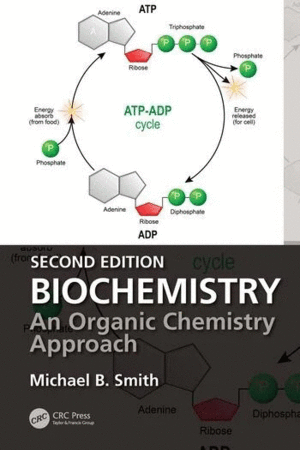
Reactions in biochemistry can be explained by an understanding of fundamental organic chemistry principles and reactions. This paradigm is extended to biochemical principles and to a myriad of biomolecules. The text provides a framework for understanding various topics in biochemistry, including the chemical behavior of biomolecules, enzyme activity, and more. It goes beyond mere memorization. Using several techniques to develop a relational understanding, including homework, this text helps students fully grasp and better correlate essential organic chemistry concepts with those at the root of biochemistry. The goal is to achieve a better understanding of the fundamental principles of biochemistry.
Key Features
• Presents a review chapter of fundamental organic chemistry principles and reactions.
• Presents and explains the fundamental principles of biochemistry using principles and common reactions of organic chemistry.
• Discusses enzymes, proteins, fatty acids, lipids, vitamins, hormones, nucleic acids and other biomolecules by comparing and contrasting them with the organic chemistry reactions that constitute the foundation of these classes of biomolecules.
• Discusses the organic synthesis and reactions of amino acids, carbohydrates, nucleic acids and other biomolecules.
 -5%
-5%
 -5%
-5%
 -5%
-5%
 -5%
-5%
 -5%
-5%
 -5%
-5%
 -5%
-5%
 -5%
-5%
 -5%
-5%
 -5%
-5%
 -5%
-5%
 -5%
-5%