Descuento:
-5%Antes:
Despues:
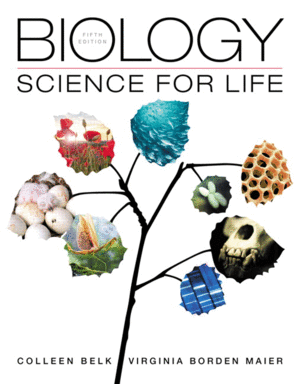
151,12 €Chapter 1: Can Science Cure the Common Cold? Introduction to the Scientific Method
• Unit One: Chemistry and Cells
Chapter 2: Science Fiction, Bad Science, and Pseudoscience: Water, Biochemistry, and Cells
Chapter 3: Is it Possible to Supplement Your Way to Better Health? Nutrients and Membrane Transport
Chapter 4: Body Weight and Health: Enzymes, Metabolism, and Cellular Respiration
Chapter 5: Life in the Greenhouse: Photosynthesis and Climate Change
• Unit Two: Genetics
Chapter 6: Cancer: DNA Synthesis, Mitosis, and Meiosis
Chapter 7: Are You Only as Smart as Your Genes? Mendelian and Quantitative Genetics
Chapter 8: DNA Detective: Complex Patterns of Inheritance and DNA Profiling
Chapter 9: Genetically Modified Organisms: Gene Expression, Mutation, Stem Cells, and Cloning
• Unit Three: Evolution
Chapter 10: Where Did We Come From? The Evidence for Evolution
Chapter 11: An Evolving Enemy: Natural Selection
Chapter 12: Who Am I? Species and Races
Chapter 13: The Greatest Species on Earth? Biodiversity and Classification
• Unit Four: Ecology
Chapter 14: Is the Human Population Too Large? Population Ecology
Chapter 15: Conserving Biodiversity: Community and Ecosystem Ecology
Chapter 16: Where Do You Live? Climate and Biomes
Features
Personalize Learning with MasteringBiology®
MasteringBiology is an online homework, tutorial, and assessment product designed to improve results by helping students quickly master concepts. Students benefit from self-paced tutorials that feature immediate wrong-answer feedback and hints that emulate the office-hour experience to help keep students on track. With a wide range of interactive, engaging, and assignable activities, students are encouraged to actively learn and retain tough course concepts.
• NEW! Interactive Storyline Activities tie the storyline of the chapter to key science concepts and ensure that students truly understand the relationship between the story and the science topics.
• EXPANDED! Working with Data questions have been added to each chapter and challenge students to analyze and apply their knowledge of biology to a graph or set of data.
• NEW! Savvy Reader: Evaluating Media activities ask students to examine selected media (web sites, articles, videos) with a critical look at the sources and methods used to convey information.
• Learning Catalytics™ is an interactive classroom tool that uses students’ smartphones, tablets, or laptops to engage them in more sophisticated tasks and thinking. Now included with student subscriptions to MasteringBiology with eText, Learning Catalytics helps to facilitate classroom discussion, and promote peer-to-peer learning with real-time analytics. Instructors can:
• Pose a variety of open-ended questions that help your students develop critical thinking skills
• Monitor responses to find out where students are struggling
• Use real-time data to adjust your instructional strategy and try other ways of engaging your students during class
• Manage student interactions by automatically grouping students for discussion, teamwork, and peer-to-peer learning
• Learning Catalytics now includes two types of questions based on the Fifth Edition of Biology: Science for Life:
- Stop and Stretch questions help to ensure that students can apply the material they have learned to new concepts.
- Sounds Right, But Is It? questions help uncover student misconceptions and work through them in class.
• NEW! Everyday Biology Videos briefly explore interesting and relevant biology topics that relate to concepts that students are learning in class. These 20 videos, produced by the BBC, can be assigned in MasteringBiology with assessment questions.
• Dynamic Study Modules allow your students to study on their own and be better prepared to achieve higher scores on their tests. A mobile app is available for iOS and Android devices for study on the go.
• BioFlix™ 3D movie-quality animations help your students visualize complex biology topics and include automatically graded coaching activities with personalized feedback and hints.
• ABC News Videos connect biology concepts to everyday life.
Engage students with relevant stories and help them develop scientific literacy skills
• UPDATED! Each chapter weaves in a story based on a current issue or hot topic through which biological concepts, examples, and applications are presented and explained. Six thoroughly revised storylines make biology topics even more relevant to today’s students:Chapter 2: Science Fiction, Bad Science, and Pseudoscience; Chapter 4: Body Weight and Health; Chapter 18: Binge Drinking Chapter 19: Clearing the Air; Chapter 21: Human Sex Differences; and Chapter 23: Study Drugs. NEW Interactive Storyline Activities can be assigned in MasteringBiology.
• Savvy Reader activities in each chapter investigate a selection of current periodicals (newspapers, journals, magazines, and websites) that relate to a discussion in the main narrative. Each excerpt is followed by critical thinking questions to help students interpret and evaluate scientific information and data found in everyday media. NEW Savvy Reader activities can be assigned in MasteringBiology.
• NEW! Working With Data questions have been added to the figure legends of selected graphs, tables, or figures, and challenge students to closely interpret the data. NEW Working with Data assignments are available for each chapter in MasteringBiology.
• NEW! Sounds Right, But Is It? activities have been added to the end of each chapter and address common student misconceptions about biology concepts. The questions in the activity are available for use in class with Learning Catalytics.
• NEW! “Flipped Classroom” Instructor’s Manual includes many activities that have been tested in the authors’ own classes. Each text chapter is supplemented with video lectures featuring Colleen Belk and Virginia Borden Maier, a selection of in-class activities, suggestions for student “pre-work” outside of class, media references, and more.
• NEW! PowerPoint presentations accompany each chapter storyline to help instructors highlight the relevance of biology to everyday life. Many of these customizable lecture slides include new video clips.
Make complex biology topics more manageable for non-science students.
• NEW! In the edition with physiology chapters, a new chapter 18 covers the digestive and urinary systems, which were previously part of the chapters on the cardiovascular and respiratory systems. This new chapter presents this material in a more manageable format for students and instructors and features a storyline on binge drinking.
• UPDATED! Roots to Remember references have been added in context within chapter discussions to help students learn the language of biology using word roots.
• EXPANDED! Visualize This questions within select figure legends encourage students to look more closely at figures to more fully understand their content.
• Analogies in the book’s narrative and art compare abstract science with familiar objects and experiences, allowing students to better grasp difficult biological concepts.
• Stop and Stretch questions are strategically placed within the text to help students pace themselves and think critically about material they have just read.
• Learning Outcomes are integrated in MasteringBiology where they can be tied directly to assessment.
• A Closer Look sections have been heavily revised, isolating particularly challenging content so instructors have flexibility to assign or skip it. “An Overview” section always appears before A Closer Look section, with the former offering the “big picture” of a concept and the latter “the details.”
About the Author(s)
Colleen Belk and Virginia Borden Maier collaborated on teaching biology to nonmajors for over a decade together at the University of Minnesota—Duluth. This collaboration has continued through Virginia’s move to St. John Fisher College in Rochester, New York, and has been enhanced by their differing but complementary areas of expertise. In addition to the non-majors course, Colleen Belk teaches general biology for majors, genetics, cell biology, and molecular biology courses. Virginia Borden Maier teaches general biology for majors, evolutionary biology, zoology, plant biology, ecology, and conservation biology courses.
 -5%
-5%
 -5%
-5%
 -5%
-5%
 -5%
-5%
 -5%
-5%
 -5%
-5%
 -5%
-5%
 -5%
-5%
 -5%
-5%
 -5%
-5%