Descuento:
-5%Antes:
Despues:
106,70 ۥ Foreword
• Acknowledgments
• I: Neurons: excitable and secretory cells that establish synapses
Chapter 1: Neurons
Chapter 2: Neuron-glial cell cooperation
Chapter 3: Ionic gradients, membrane potential and ionic currents
Chapter 4: The voltage-gated channels of Na+ action potentials
Chapter 5: The voltage-gated channels of Ca2+ action potentials: Generalization
Chapter 6: The chemical synapses
Chapter 7: Neurotransmitter release
• II: Ionotropic and metabotropic receptors in synaptic transmission
Chapter 8: The ionotropic nicotinic acetylcholine receptors
Chapter 9: The ionotropic GABAA receptor
Chapter 10: The ionotropic glutamate receptors
Chapter 11: The metabotropic GABAB receptors
Chapter 12: The metabotropic glutamate receptors
• III: Somato-dendritic processing and plasticity of postsynaptic potentials
Chapter 13: Somato-dendritic processing of postsynaptic potentials I: Passive properties of dendrites
Chapter 14: Subliminal voltage-gated currents of the somato-dendritic membrane
Chapter 15: Somato-dendritic processing of postsynaptic potentials II. Role of sub-threshold depolarizing voltage-gated currents
Chapter 16: Somato-dendritic processing of postsynaptic potentials III. Role of high-voltage-activated depolarizing currents
Chapter 17: Firing patterns of neurons
Chapter 18: Synaptic plasticity
• IV: The hippocampal network
Chapter 19: The adult hippocampal network
Chapter 20: Maturation of the hippocampal network
• Contributors
• Index
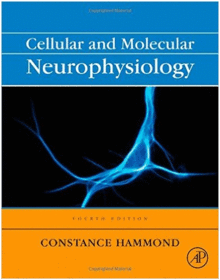
This third edition is the new, thoroughly revised edition of the only current, established and authoritative text focusing on the cellular and molecular physiology of nerve cells. Previously titled Cellular and Molecular Neurobiology, the new title better reflects this focus. The book is hypothesis driven rather than just presenting the facts, and the content is firmly based on numerous experiments performed by the top experts in the field. While the book does cover the important facts, it also presents the background for how researchers arrived at this knowledge to provide a context for the field. It teaches not only how excitable cells work in detail, but also how to construct and conduct intelligent research experiments. This book promotes a real understanding of the function of nerve cells that is useful for practicing neurophysiologists and students in a graduate-level course on the topic alike.
Features:
• 70% new or updated material in full color throughout, with more than 350 carefully selected and constructed illustrations
• Fifteen appendices describing neurobiological techniques are interspersed in the text
• Accompanying Instructor website with exercises and Companion website available
Author
Constance Hammond, Director of Research INSERM U901, Institut de Neurobiologie de la Méditerranée, Marseilles, France.
 -5%
-5%
 -5%
-5%
 -5%
-5%
 -5%
-5%
 -5%
-5%
 -5%
-5%
 -5%
-5%
 -5%
-5%
 -5%
-5%
 -5%
-5%