Descuento:
-5%Antes:
Despues:
39,90 €Introduction
Part I. The Algebraic Environment:
1. Groups and vector spaces
2. Algebras, representations and modules
3. Multilinear algebra
Part II. Quadratic Forms and Clifford Algebras:
4. Quadratic forms
5. Clifford algebras
6. Classifying Clifford algebras
7. Representing Clifford algebras
8. Spin
Part III. Some Applications:
9. Some applications to physics
10. Clifford analyticity
11. Representations of Spind and SO(d)
12. Some suggestions for further reading
Bibliography
Glossary
Index.
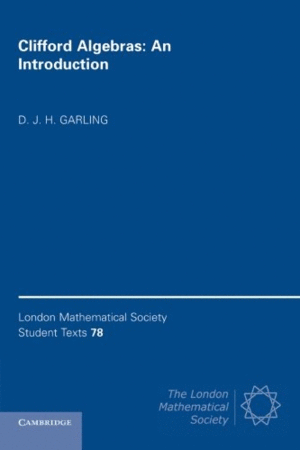
Clifford algebras, built up from quadratic spaces, have applications in many areas of mathematics, as natural generalizations of complex numbers and the quaternions. They are famously used in proofs of the Atiyah–Singer index theorem, to provide double covers (spin groups) of the classical groups and to generalize the Hilbert transform. They also have their place in physics, setting the scene for Maxwell's equations in electromagnetic theory, for the spin of elementary particles and for the Dirac equation. This straightforward introduction to Clifford algebras makes the necessary algebraic background - including multilinear algebra, quadratic spaces and finite-dimensional real algebras - easily accessible to research students and final-year undergraduates. The author also introduces many applications in mathematics and physics, equipping the reader with Clifford algebras as a working tool in a variety of contexts.
Features
• Suitable for working mathematicians and physicists who work with Clifford algebras and their applications
• Chapters are self-contained to suit readers of various levels from undergraduate to professional
• Includes suggestions for further study
Author
D. J. H. Garling, University of Cambridge. Fellow of St John's College and Emeritus Reader in Mathematical Analysis at the University of Cambridge, in the Department of Pure Mathematics and Mathematical Statistics.
 -5%
-5%
 -5%
-5%
 -5%
-5%
 -5%
-5%
 -5%
-5%
 -5%
-5%
 -5%
-5%
 -5%
-5%
 -5%
-5%
 -5%
-5%