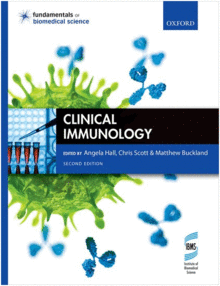
HALL, A.; SCOTT, C.; BUCKLAND, M.
Descuento:
-5%Antes:
Despues:
47,42 €1: Angela Hall and Christopher Baldwin: Introduction to the clinical immunology laboratory
2: Lynn Follows and Phillip A Whitfield: Immunoglobulins
3: Kirsty Swallow: Allergy
4: Mo Moody, Tariq El-Shanawany, Paul Williams, B Paul Morgan and Stephen Jolles: Complement
5: Chris Scott: Autoimmune rheumatological disease
6: Angela Hall: Autoimmune kidney disease
7: Robert Lock: Organ specific autoimmunity
8: Robert Lock, Sarah Johnston and Philip Bright: Autoimmune skin disorders
9: Edward Davies: Autoimmune liver disease
10: Abid R Karim and Saiju Jacob: Neuroimmunology
11: Dawn Barge: Flow cytometry and primary immunodeficiency
12: Alison Cox: Human immunodeficiency virus (HIV)
13: David Wilson and Vaughan Carter: Histocompatibility and immunogenetics
Biomedical scientists are the foundation of modern healthcare, from cancer screening to diagnosing HIV, from blood transfusion for surgery to food poisoning and infection control. Without biomedical scientists, the diagnosis of disease, the evaluation of the effectiveness of treatment, and research into the causes and cures of disease would not be possible.
The Fundamentals of Biomedical Science series has been written to reflect the challenges of practicing biomedical science today. It draws together essential basic science with insights into laboratory practice to show how an understanding of the biology of disease is coupled to the analytical approaches that lead to diagnosis.
Assuming only a minimum of prior knowledge, the series reviews the full range of disciplines to which a Biomedical Scientist may be exposed - from microbiology to cytopathology to transfusion science.
Clinical Immunology gives the new biomedical scientist an insight into the function of the immune system, the front line of defence against pathological disease, and the diagnostic techniques used to identify associated malfunctions and disorders. By examining the key immunological principles and scientific basis of laboratory techniques with a focus on the biomedical scientist's role in the diagnostic laboratory, the reader is provided with everything needed to prepare for a specialist qualification in immunology. Current tests, the rationale behind their use, the technologies employed, and the quality measures applied are illustrated by specific case studies showing how the clinician interprets the results to help the patient.
Online Resource Centre
The Online Resource Centre to accompany Clinical Immunology features:
For registered adopters of the book:
• Figures from the book, available to download
For students:
• Answers to self-check and end of chapter questions
• Video podcasts including interviews with practicing biomedical scientists and 'in the lab' footage showing biomedical science in practice
Features:
• A blend of science theory and biomedical science practice make this series ideal for those seeking both the knowledge and skills to become proficient Biomedical Scientists
• Case studies enrich the text and emphasise clinical relevance
• Self-test and discussion questions, with answers provided online, encourage students to analyse the text and develop their problem solving skills
• The book is augmented by an Online Resource Centre, which includes video interviews with practicing biomedical scientists and 'in the lab' footage showing biomedical science in practice
New to this Edition:
• New chapter on autoimmune skin disorders explaining the clinical features of these diseases, assays and techniques used to test for them, and methods of treatment.
• New chapter on histocompatibility and immunogenetics to describe the human leukocyte antigen (HLA) system and its role in transplantation and disease, and to introduce methods used in the clinical H&I laboratory.
Authors
• Angela Hall, CSci FIBMS, Laboratory Manager, Department of Infection and Immunity, Imperial College Healthcare NHS Trust.
• Chris Scott, Mr, Department of Immunology, Barts and the London NHS Trust.
• Matthew Buckland, Dr, Department of Immunology, Barts and the London NHS Trust
 -5%
-5%
 -5%
-5%
 -5%
-5%
 -5%
-5%
 -5%
-5%
 -5%
-5%
 -5%
-5%
 -5%
-5%
 -5%
-5%
 -5%
-5%