Descuento:
-5%Antes:
Despues:
47,50 €1. Types of memory and brain regions of interest
2. The tools of cognitive neuroscience
3. Brain regions associated with long-term memory
4. Brain timing associated with long-term memory
5. Long-term memory failure
6. Working memory
7. Implicit memory
8. Memory and other cognitive processes
9. Explicit memory and disease
10. Long-term memory in animals
11. The future of memory research
Glossary
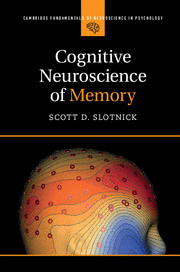
Within the last two decades, the field of cognitive neuroscience has begun to thrive, with technological advances that non-invasively measure human brain activity. This is the first book to provide a comprehensive and up-to-date treatment on the cognitive neuroscience of memory. Topics include cognitive neuroscience techniques and human brain mechanisms underlying long-term memory success, long-term memory failure, working memory, implicit memory, and memory and disease. Cognitive Neuroscience of Memory highlights both spatial and temporal aspects of the functioning human brain during memory. Each chapter is written in an accessible style and includes background information and many figures. In his analysis, Scott D. Slotnick questions popular views, rather than simply assuming they are correct. In this way, science is depicted as open to question, evolving, and exciting.
Features
• Offers a detailed overview of terminology, techniques, and findings in the cognitive neuroscience of memory
• Written accessibly so that students without a background in psychology or neuroscience can engage with the text
• Employs helpful figures throughout each chapter to clearly present abstract or complex data
Author
Scott D. Slotnick, Boston College, Massachusetts
Scott D. Slotnick is an Associate Professor of Psychology at Boston College, Massachusetts, Editor-in-Chief of the journal Cognitive Neuroscience, and author of the book Controversies in Cognitive Neuroscience (2012). He employs multiple cognitive neuroscience techniques to investigate the brain mechanisms underlying memory, including functional magnetic resonance imaging (fMRI), electroencephalography (EEG), and transcranial magnetic stimulation (TMS).
 -5%
-5%
 -5%
-5%
 -5%
-5%
 -5%
-5%
 -5%
-5%
 -5%
-5%
 -5%
-5%
 -5%
-5%
 -5%
-5%
 -5%
-5%