Descuento:
-5%Antes:
Despues:
43,47 ۥ Part I. Fundamentals:
1. Introduction: importance, implications, and historical perspectives
2. Fundamentals: biological and technological bases
3. Theoretical approaches: models and metaphors
4. Research: modes and methods
• Part II. Systems:
5. Sensory-motor interfaces: input and output
6. Virtual environments
7. Learning and memory, transfer and interference
8. Thinking and problem solving
9. Language and programming
• Part III. Relationships:
10. Individual differences: people, performance, and personality
11. Motivation, emotion, and affective computing
12. Social media and interpersonal relations
13. Cyberpathologies and cybertherapies
• Part IV. Applications:
14. Automation and artificial intelligence
15. Assistive technologies
16. Video games and entertainment
17. Technology and education
18. Cybersecurity
19. The future: the ultimate human-computer interface.
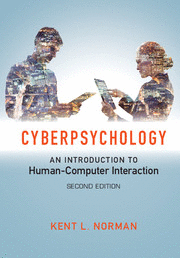
This textbook provides a comprehensive overview of the human-computer interface in clear, non-technical language, making it an ideal introduction for students of both psychology and computer science. Covering the past, present, and future developments in technology and psychology, it combines cutting-edge academic research with engaging illustrations and examples that show students how the material relates to their lives. Topics addressed include: human factors of input devices, and the basics of sensation and perception; memory and cognitive issues of users navigating their way through interfaces; communication via programming languages and natural speech interaction; cyberpathologies such as techno-stress and Internet addiction disorders; and challenges surrounding automation and artificial intelligence. This thoroughly updated second edition features new chapters on virtual reality and cybersecurity; expanded coverage of social media, mobile computing, e-learning, and video games; and end-of-chapter review questions that ensure students have mastered key objectives.
Features
• Explains psychology and computer science concepts in non-technical terms so that the material is accessible to students from either background
• This updated and more comprehensive edition includes additional material on virtual reality, cybersecurity, e-learning, and video games
• Opening chapter narrative scenarios provide students with context for how the material can have real-life impacts
• Pedagogical features include chapter overviews, review questions, suggested exercises and detailed figures to help illustrate the material
Author
Kent Norman, University of Maryland, College Park. Associate Professor of Psychology and Director of the Laboratory for Automation Psychology and Decision Processes at the University of Maryland, College Park. He is a founding member of the Human-Computer Interaction Laboratory in the College of Information Studies. He is the author or coauthor of more than eighty journal articles and book chapters, and his research has been funded by organizations such as the United States Census Bureau and the National Science Foundation. He developed HyperCourseware™, a web-based prototype, and coauthored the Questionnaire for User Interaction Satisfaction (QUIS™), a tool to assess users' subjective satisfaction with specific aspects of the human-computer interface.
 -5%
-5%
 -5%
-5%
 -5%
-5%
 -5%
-5%
 -5%
-5%
 -5%
-5%
 -5%
-5%
 -5%
-5%
 -5%
-5%
 -5%
-5%