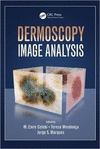
CELEBI, M.; MENDONCA, T.; MARQUES, J.
Descuento:
-5%Antes:
Despues:
161,04 €Demoscopy is a non-invasive skin imaging technique that uses optical magnification and either liquid immersion or cross- polarized lighting that makes subsurface structures more easily visible when compared to conventional clinical images. It allows the identification of dozens of morphological features, which is particularly important related to malignant melanoma. This book summarizes the state of the art for this exciting subfield within medical image analysis.
Features
- Provides complete coverage of dermoscopy image analysis, from preprocessing to classification
- Discusses state-of-the-art techniques and algorithms for dermoscopy image analysis
- Each chapter is authored by a leading expert in the field, from four different continents
- Contains numerous examples, illustrations, and tables summarizing results from quantitative studies
Editor(s) Bio
M. Emre Celebi earned a B.Sc in computer engineering at the Middle East Technical University, Ankara, Turkey, in 2002. He earned M.Sc and Ph.D degrees in computer science and engineering at the University of Texas at Arlington, USA, in 2003 and 2006, respectively. A senior member of the IEEE and SPIE, he is currently an associate professor and the founding director of the Image Processing and Analysis Laboratory, Department of Computer Science, Louisiana State University, Shreveport, USA. Widely published, Dr. Celebi has worked on several projects funded by the U.S. National Science Foundation and National Institutes of Health.
Teresa F. Mendonça earned mathematics and Ph.D degrees at the University of Porto, Portugal, in 1980 and 1993, respectively. Currently, she is an assistant professor with the Mathematics Department, Faculty of Sciences, University of Porto, and a researcher at the Institute for Systems and Robotics–Porto. Her research interests are in the areas of identification, modeling, and control applied to the biomedical field. In recent years, she has been involved in projects for modeling and control in anesthesia and in medical image analysis.
Jorge S. Marques earned EE, Ph.D, and aggregation degrees at the Technical University of Lisbon, Portugal, in 1981, 1990, and 2002, respectively. Currently, he is an associate professor with the Electrical and Computer Engineering Department, Instituto Superior Técnico, Lisbon, Portugal, and a researcher at the Institute for Systems and Robotics, Portugal. He was the co-chairman of the IAPR Conference IbPRIA 2005, president of the Portuguese Association for Pattern Recognition (2001–2003), and associate editor of the Statistics and Computing Journal, Springer. His research interests are in the areas of statistical image processing, medical image analysis, and pattern recognition.
Table of Contents
Toward a Robust Analysis of Dermoscopy Images Acquired under Different Conditions
A Bioinspired Color Representation for Dermoscopy Image Analysis
Where’s the Lesion? Variability in Human and Automated Segmentation of Dermoscopy Images of Melanocytic Skin Lesions
A State-of-the-Art Survey on Lesion Border Detection in Dermoscopy Images
Comparison of Image Processing Techniques for Reticular Pattern Recognition in Melanoma Detection
Global Pattern Classification in Dermoscopic Images
Streak Detection in Dermoscopic Color Images Using Localized Radial Flux of Principal Intensity Curvature
Dermoscopy Image Assessment Based on Perceptible Color Regions
Improved Skin Lesion Diagnostics for General Practice by Computer-Aided Diagnostics
Accurate and Scalable System for Automatic Detection of Malignant Melanoma
Early Detection of Melanoma in Dermoscopy of Skin Lesion Images by Computer Vision-Based System
From Dermoscopy to Mobile Teledermatology
PH2: A Public Database for the Analysis of Dermoscopic Images
 -5%
-5%
 -5%
-5%
 -5%
-5%
 -5%
-5%
 -5%
-5%
 -5%
-5%
 -5%
-5%
 -5%
-5%
 -5%
-5%
 -5%
-5%