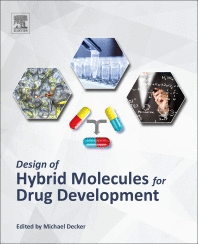
Descuento:
-5%Antes:
Despues:
146,22 €1. Introduction
2. Multitarget-Directed Antioxidants as Therapeutic Agents: Putting the Focus on the Oxidative Stress
• Abstract
• Abbreviations
• 2.1 Introduction
• 2.2 Melatonin Hybrids
• 2.3 Ferulic Acid Hybrids
• 2.4 Conclusions
• References
3. Towards Gaseous Mediator Hybrid Drugs
• Abstract
• 3.1 Introduction: Gaseous Mediators NO, H2S, and CO
• 3.2 The Toolbox: Synthetic Donor Moieties for NO and H2S Release
• 3.3 NO and H2S Hybrid Drugs Candidates
• 3.4 Carbon Monoxide Donor Compounds, Design, and Hybrid Drugs
• 3.5 Overview, Challenges, and Concluding Remarks
• References
4. Designed Hybrid Compounds for Tropical Parasitic Diseases
• Abstract
• 4.1 General Introduction
• 4.2 Major Tropical Parasitic Diseases
• 4.3 Hybrid Molecules for Tropical Parasitic Infections
• 4.4 Conclusions
• 4.5 Future Prospects
• References
5. Dual-Acting Compounds Acting as Receptor Ligands and Enzyme Inhibitors
• Abstract
• 5.1 Introduction
• 5.2 Challenges
• 5.3 Approaches and Examples
• 5.4 Multifunctional Ligands for the Treatment of Pain
• 5.5 Multifunctional Ligands for the Treatment of CNS Diseases
• 5.6 Multitarget Compounds for the Treatment of Cardiovascular Diseases
• 5.7 Conclusion
• References
6. Multitarget Anti-Alzheimer Hybrid Compounds: Do They Work In Vivo?
• Abstract
• List of Abbreviations
• 6.1 Multitarget Therapies Against Alzheimer’s Disease
• 6.2 Pharmacophore Combination Approach: Pros, Cons, and Challenges of Anti-Alzheimer Hybrid Compounds
• 6.3 Evolution of Multitarget Anti-Alzheimer Drug Discovery
• 6.4 In Vivo Efficacy Studies With Multitarget Anti-Alzheimer Hybrid Compounds
• 6.5 Conclusions
• References
7. Anticancer Hybrids
• Abstract
• 7.1 Introduction
• 7.2 Hybrid Drug Design for Cancer Treatment
• 7.3 Methods to Construct Anticancer Hybrids
• 7.4 Clinical Application of Hybrid Anticancer Drugs
• 7.5 Cancer Cell-Targeting Hybrids
• 7.6 Future Prospects
• Acknowledgement
• References
8. Molecular Hybridization: An Emerging Tool for the Design of Novel Therapeutics for Alzheimer’s Disease
• Abstract
• 8.1 Introduction
• 8.2 Molecular Hybridization and Pharmacophore Conjugation: Practical Methods for the Design of Multifunctional Drugs for AD
• 8.3 Summary
• References
9. Computational Methods in Multitarget Drug Discovery
• Abstract
• 9.1 Introduction
• 9.2 Methods to Identify Target Combinations
• 9.3 Computationally Driven Multitarget Hit Discovery
• 9.4 Computationally Driven Optimization of Multitarget Hits
• 9.5 Perspective and Outlook
• 9.6 Conclusions
• References
10. Medicinal Chemistry of Hybrids for Neurodegenerative Diseases
• Abstract
• 10.1 Introduction
• 10.2 Design Strategies for Merged, Linked, and Fused Hybrids
• 10.3 Hybrids for Alzheimer’s Disease
• 10.4 Hybrids for Prion Diseases
• 10.5 Conclusions
• References
11. Photoresponsive Hybrid Compounds
• Abstract
• 11.1 Introduction
• 11.2 Light as an External Stimulus
• 11.3 Molecular Photoswitches
• 11.4 Design and Synthesis
• 11.5 Targets
• 11.6 Conclusion
• References
• Highlights an approach unimpaired by the limitations of the classical search for lead structures - one of the core problems in modern drug development processes, making the content of high relevance for both academic and non-academic drug development processes
• Pulls together research and design techniques in a novel way to give researchers the best possible platform from which to review the approaches and techniques applied
• Compares the advantages and disadvantages of these compounds
• Includes the very latest developments, such as photoactivatable and photo-responsive drugs
Author
Michael Decker, Professor of Pharmaceutical and Medicinal Chemistry, Institute of Pharmacy and Food Chemistry, Julius-Maximilians-Universität Würzburg, Germany
 -5%
-5%
 -5%
-5%
 -5%
-5%
 -5%
-5%
 -5%
-5%
 -5%
-5%
 -5%
-5%
 -5%
-5%
 -5%
-5%
 -5%
-5%