Descuento:
-5%Antes:
Despues:
270,47 €Ch. 1 The Making of Body and a Field: Introduction to Developmental Biology
Ch. 2 Specifying Identity: Mechanisms of Developmental Patterning
Ch. 3 Differential Gene Expression: Mechanisms of Cell Differentation
Ch. 4 Cell-to-Cell Communication: Mechanisms of Cell Differentiation
Ch. 5 Stem Cells: Their Potential and Their Niches
Ch. 6 Sex Determination and Gametogenesis
Ch. 7 Fertilization: Beginning a New Organism
Ch. 8 Conceptualizing Early Development: Essential Processes
Ch. 9 Snails, Flowers and Nematodes: Different Mechanisms for Similar Patterns of Specification
Ch. 10 The Genetics of Axis Specification Drosophila
Ch. 11 Sea Urchins and Tunicates
Ch. 12 Amphibians and Fish
Ch. 13 Birds and Mammals
Ch. 14 Early Human Development
Ch. 15 Neural Tube Formation and Patterning
Ch. 16 Brain Growth
Ch. 17 Neural Crest Cells and Axonal Specificity
Ch. 18 Ectodermal Placodes and the Epidermis
Ch. 19 Paraxial Mesoderm: The Somites and Their Derivatives
Ch. 20 Intermediate and Lateral Plate Mesoderm: Heart, Blood, and Kidneys
Ch. 21 Development of the Tatrapod Limb
Ch. 22 The Endoderm: Tubes and organs for Digestion and Respiration
Ch. 23 Metamorphosis: The Hormonal Reactivation of Development
Ch. 24 Regeneration
Ch. 25 The Environmental and Symbiotic Regulation of Development
Ch. 26 Developmental Mechanisms of Evolutionary Change
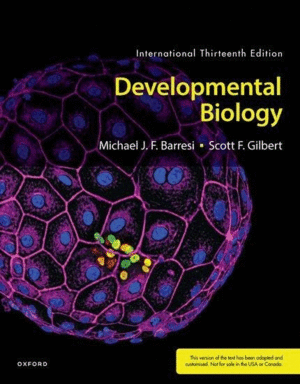
This text takes a balanced and modern approach, presenting the exciting developments in the field, and making the most complex topics understandable to a new generation of students.
Developmental Biology, Thirteenth Edition, accommodates the needs of both beginners and advanced students by clearly distinguishing the main subject matter from the details needed by advanced students.
An enhanced eBook contains videos, interviews, tutorials, and interactive features. This market-leading text embodies the breadth, intellectual rigor, and wonder of contemporary developmental biology.
Features
• Synthesizes breakthroughs in this rapidly evolving discipline in a succinct, organized manner.
• A student-centered approach empowers students to craft their own learning.
• Art program helps students visualize and tie together key concepts.
• Scientist Speak interviews with world-renowned luminaries highlight the process of science and methods used in developmental research.
• "Further Development" feature-makes for easy distinction between foundational and advanced coverage in each chapter offering teaching flexibility.
• Primary literature appendix helps students with developmental research.
• Rich pedagogy empowers instructors to effectively deliver the principles and cutting-edge developments while engaging students in learning with superb visuals and active learning.
New to this Edition:
• New Chapter 8, "Conceptualizing Early Development" is a new fully integrated chapter providing a coherent narrative on early development.
• New Chapter 14, "Early Human Development," engages students by focusing on advances in stem cell biology and biomedical visualization and their impacts on the current understanding of early human development.
• Significant revision of Chapter 24: Regeneration.
• "Dev Tutorial Videos" offer author-led video tutorials on central concepts of developmental biology, now with self-assessment.
• "Scientists Speak" videos give students the opportunity to hear leading scientists in the field of developmental biology to discuss their work.
• "Watch Development" videos illustrate developmental biology phenomena and concepts. o Narrated Interactive Figures - Author Michael Barresi breaks down essential text figures, detailing cause and effect relationships and sequences, with self-assessment.
• Narrated Interactive Figures - Author Michael Barresi breaks down essential text figures, detailing cause and effect relationships and sequences, with self-assessment.
• Assignable End of Chapter Quizzes.
• Further Development Online features - provide in-depth discussions and related to concepts introduced in the text.
 -5%
-5%
 -5%
-5%
 -5%
-5%
 -5%
-5%
 -5%
-5%
 -5%
-5%
 -5%
-5%
 -5%
-5%
 -5%
-5%
 -5%
-5%