Descuento:
-5%Antes:
Despues:
92,15 ۥ Introduction
The beginning of knot theory
Reidemeister moves and invariants
Combinatorial knot theory
Genera of knots
Overview of results
Issues of presentation
Further applications
• Preliminaries
Knots and diagrams
Crossing number and writhe
Knotation and not-tables
Seifert surfaces and genera
Graphs
Diagrammatic moves
Braids and braid representations
Link polynomials
MWF inequality, Seifert graph, and graph index
The signature
Genus generators
Knots vs. links
• The maximal number of generator crossings and ~-equivalence classes
Generator crossing number inequalities
An algorithm for special diagrams
Proof of the inequalities
Applications and improvements
• Generators of genus 4
• Unknot diagrams, non-trivial polynomials, and achiral knots
Some preparations and special cases
Reduction of unknot diagrams
Simplifications
Examples
Non-triviality of skein and Jones polynomial
On the number of unknotting Reidemeister moves
Achiral knot classification
• The signature
• Braid index of alternating knots
Motivation and history
Hidden Seifert circle problem
Modifying the index
Simplified regularization
A conjecture
• Minimal string Bennequin surfaces
Statement of result
The restricted index
Finding a minimal string Bennequin surface
• The Alexander polynomial of alternating knots
Hoste’s conjecture
The log-concavity conjecture
Complete linear relations by degree
• Outlook
Legendrian invariants and braid index
Minimal genus and fibering of canonical surfaces
Wicks forms, markings, and enumeration of alternating knots by genus
Crossing numbers
Canonical genus bounds hyperbolic volume
The relation between volume and the slN polynomial
Everywhere equivalent links
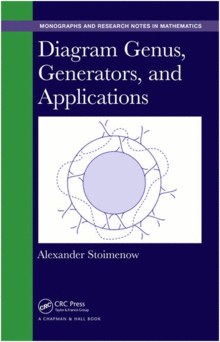
In knot theory, diagrams of a given canonical genus can be described by means of a finite number of patterns ("generators"). Diagram Genus, Generators and Applications presents a self-contained account of the canonical genus: the genus of knot diagrams. The author explores recent research on the combinatorial theory of knots and supplies proofs for a number of theorems.
The book begins with an introduction to the origin of knot tables and the background details, including diagrams, surfaces, and invariants. It then derives a new description of generators using Hirasawa’s algorithm and extends this description to push the compilation of knot generators one genus further to complete their classification for genus 4. Subsequent chapters cover applications of the genus 4 classification, including the braid index, polynomial invariants, hyperbolic volume, and Vassiliev invariants. The final chapter presents further research related to generators, which helps readers see applications of generators in a broader context.
Features
• Provides one of the first research-level treatments of canonical Seifert surfaces
• Gives a detailed structure theorem for canonical Seifert surfaces of a given genus
• Uses the structure theorem to describe the surfaces of genus 4
• Presents extensive applications, including the braid index of alternating knots, the Bennequin surface, the trapezoidal and Hoste conjectures, and hyperbolic volume
• Includes the necessary background material in the introductory chapters
• Offers knot tables and diagrams, including generators of genus 2, 3, and 4, on the author’s
Author
Alexander Stoimenow is an assistant professor in the GIST College at the Gwangju Institute of Science and Technology. He was previously an assistant professor in the Department of Mathematics at Keimyung University, Daegu, South Korea. His research covers several areas of knot theory, with relations to combinatorics, number theory, and algebra. He earned a PhD from the Free University of Berlin.
 -5%
-5%
 -5%
-5%
 -5%
-5%
 -5%
-5%
 -5%
-5%
 -5%
-5%
 -5%
-5%
 -5%
-5%
 -5%
-5%
 -5%
-5%