Descuento:
-5%Antes:
Despues:
138,31 €Table of contents (15 chapter)
1.Why and How Epstein-Barr Virus Was Discovered 50 Years Ago
2.Tumor Associations of EBV—Historical Perspectives
3.EBV-Specific Immune Response: Early Research and Personal Reminiscences
4.Epstein–Barr Virus Strain Variation
5.Chromatin Structure of Epstein–Barr Virus Latent Episomes
6.The Epigenetic Life Cycle of Epstein–Barr Virus
7.Epstein–Barr Virus: From the Detection of Sequence Polymorphisms to the Recognition of Viral Types
8.EBV Persistence—Introducing the Virus
9.Infectious Mononucleosis
10.Primary Immunodeficiencies Associated with EBV Disease
11.Burkitt’s Lymphoma
12.Contribution of the Epstein-Barr Virus to the Pathogenesis of Hodgkin Lymphoma
13.The Role of EBV in the Pathogenesis of Diffuse Large B Cell Lymphoma
14.Nasopharyngeal Carcinoma: An Evolving Role for the Epstein–Barr Virus
15.EBV and Autoimmunity
- Epstein on the discovery of EBV 50 years ago
- 32 comprehensive chapters on EBV virology, tumorigenesis and
immune control
- Newest insights on EBV strain variation, the recombinant EBV system
and in vivo models of infection
- Comprehensive account of EBV associated diseases, including
autoimmune diseases
- Update on EBV specific therapies including adoptive T cell transfer
and new vaccine formulations
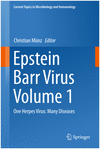
Epstein Barr virus (EBV) was discovered as the first human tumor virus around 50 years
ago. Since its discovery in Burkitt’s lymphoma it has been associated with various other
malignancies, infectious mononucleosis and even autoimmune diseases. The two book
volumes on EBV summarize the first 50 years of research on this tumor virus, starting
with historical perspectives on discovery, oncogenicity and immune control, reviewing
the role that the virus plays in the various associated diseases and concluding with a
discussion on how the immune system keeps persistent EBV infection under control in
healthy EBV carriers and can be used to treat EBV associated diseases. The respective
32 chapters are written by international experts from three continents for health care
providers, biomedical researchers and patients that are affected by EBV. The assembled
knowledge should help to understand EBV associated diseases better and to develop EBV
specific vaccination in the near future.
 -5%
-5%
 -5%
-5%
 -5%
-5%
 -5%
-5%
 -5%
-5%
 -5%
-5%
 -5%
-5%
 -5%
-5%
 -5%
-5%
 -5%
-5%