Descuento:
-5%Antes:
Despues:
148,20 €Part I: Solutions of the Einstein Vacuum Equations, Lydia Bieri 1
Chapter 1. Introduction 11
Chapter 2. Preliminary Tools 43
Chapter 3. Main Theorem 51
Chapter 4. Comparison 69
Chapter 5. Error Estimates 105
Chapter 6. Second Fundamental Form k: Estimates for the
Components of k 167
Chapter 7. Second Fundamental Form ?: Estimating ? and ? 189
Chapter 8. Uniformization Theorem 221
Chapter 9. ? on the Surfaces S – Changes in r and s 241
Chapter 10. The Last Slice 247
Appendix A. Curvature Tensor – Components 283
Appendix B. Uniformization Theorem: Standard Situation,
Cases 1 and 2 285
Bibliography 291
Index 293
Part II: Solutions of the Einstein-Maxwell Equations, Nina Zipser 297
Chapter 1. Introduction 307
Chapter 2. Norms and Notation 321
Chapter 3. Existence Theorem 337
Chapter 4. The Electromagnetic Field 343
Chapter 5. Error Estimates for F 363
Chapter 6. Interior Estimates for F 413
Chapter 7. Comparison Theorem for the Weyl Tensor 425
Chapter 8. Error Estimates for W 439
Chapter 9. Second Fundamental Form 453
Chapter 10. The Lapse Function 465
Chapter 11. Optical Function 471
Chapter 12. Conclusion 485
Bibliography 491
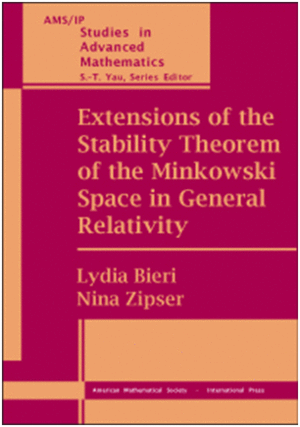
A famous result of Christodoulou and Klainerman is the global nonlinear stability of Minkowski spacetime. In this book, Bieri and Zipser provide two extensions to this result. In the first part, Bieri solves the Cauchy problem for the Einstein vacuum equations with more general, asymptotically flat initial data, and describes precisely the asymptotic behavior. In particular, she assumes less decay in the power of rr and one less derivative than in the Christodoulou–Klainerman result. She proves that in this case, too, the initial data, being globally close to the trivial data, yields a solution which is a complete spacetime, tending to the Minkowski spacetime at infinity along any geodesic. In contrast to the original situation, certain estimates in this proof are borderline in view of decay, indicating that the conditions in the main theorem on the decay at infinity on the initial data are sharp.
In the second part, Zipser proves the existence of smooth, global solutions to the Einstein–Maxwell equations. A nontrivial solution of these equations is a curved spacetime with an electromagnetic field. To prove the existence of solutions to the Einstein–Maxwell equations, Zipser follows the argument and methodology introduced by Christodoulou and Klainerman. To generalize the original results, she needs to contend with the additional curvature terms that arise due to the presence of the electromagnetic field FF; in her case the Ricci curvature of the spacetime is not identically zero but rather represented by a quadratic in the components of FF. In particular the Ricci curvature is a constant multiple of the stress-energy tensor for FF. Furthermore, the traceless part of the Riemann curvature tensor no longer satisfies the homogeneous Bianchi equations but rather inhomogeneous equations including components of the spacetime Ricci curvature. Therefore, the second part of this book focuses primarily on the derivation of estimates for the new terms that arise due to the presence of the electromagnetic field
Authors
• Lydia Bieri: Harvard University, Cambridge, MA,
• Nina Zipser: Harvard University, Cambridge, MA
 -5%
-5%
 -5%
-5%
 -5%
-5%
 -5%
-5%
 -5%
-5%
 -5%
-5%
 -5%
-5%
 -5%
-5%
 -5%
-5%
 -5%
-5%