Descuento:
-5%Antes:
Despues:
397,18 ۥ Part I: General Principles
Surgical Anatomy of the Face.
Attractiveness, Proportions, and Ethnic Reflections of Allure.
Imaging for Facial Surgery.
Wound Healing and Optimization, Including Skin Grafting, Tissue Expansion, and Soft Tissue Techniques.
Flap Reconstruction: Local, Regional, and Free Tissue Design Principles.
Principles of Facial Aging.
• Part II: Facial Surgery by Anatomic Site
• Section I: Scalp and Forehead
Scalp Reconstruction.
Hair Restoration and Scalp Surgery.
Brow Lift.
• Section II: The Eyelids and Orbit
Eyelid Malpositions: Entropion and Ectropion.
Eyelid Reconstruction.
Ptosis Repair.
Orbital Fractures.
Blepharoplasty.
• Section III: The Nose
Acute Nasal Injuries.
Surgery of the Nasal Septum.
Closed Rhinoplasty.
Open Rhinoplasty.
Revision Rhinoplasty.
Local Flaps for Nasal Reconstruction.
Special Problems in Nasal Reconstruction.
The Total Rhinectomy Defect.
• Section IV: The Ear
Acute Auricular Injuries.
Local Flaps for Auricular Reconstruction.
Microtia Reconstruction.
Otologic Considerations in Microtia and Atresia.
Otoplasty: Surgical Correction of the Prominent Ear.
• Section V: Bony Facial Skeleton
Nasoethmoid Complex, Frontal Sinus, and Skull Base Fractures.
Midface Fractures.
Mandibular Fractures.
Implants and Skeletal Modifications.
Free Tissue for Reconstruction of the Bony Facial Skeleton.
• Section VI: Facial Skin and Soft Tissue
Soft Tissue Injuries of the Face.
Scar Revision.
Local Flaps for Facial Reconstruction, Including Cheek and Lip Defects.
Pedicled Flaps for Facial Reconstruction.
Free Flaps for Facial Skin and Soft Tissue Reconstruction.
Benign and Malignant Cutaneous Neoplasms.
Melanoma of the Head and Neck.
Rhytidectomy.
Skin Resurfacing: Laser, Chemical Peels, and Mechanical Dermabrasion.
Volume Replacement and Chemodenervation in the Aging Face.
• Part III: Conditions Affecting Multiple Facial Zones or Tissues
Impaired Facial Movement: Paralysis, Synkinesis, and Spasm.
Craniofacial Surgery.
Cleft Lip and Palate Repair.
Secondary Cleft Palate and Velopharyngeal Function.
Congenital Vascular Anomalies of the Head and Neck.
• Part IV: Emerging Trends and New Directions in Facial Plastic Surgery
Facial Transplantation.
Evaluating Patient Outcomes in Facial Plastic Surgery.
Tissue Engineering for Facial Plastic Surgery.
The Role of Facial Surgery in Global Health and Surgical Education.
• Provides a comprehensive resource on facial aesthetic and reconstructive plastic surgery
• Features world-renowned editors and contributors drawn from the fields of facial plastic surgery, otolaryngology, and dermatology
• Emphasizes evidence-based medicine—a major force in medicine today
• Presents step-by-step procedures accompanied by beautiful medical illustrations
• Includes four DVDs containing operative videos
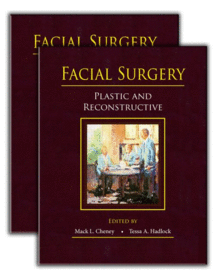
Facial Surgery: Plastic and Reconstructive covers the full range of aesthetic and reconstructive techniques in facial plastic surgery. Now presented in two volumes, the set represent the evolution and significant expansion of Dr. Cheney’s earlier work that was widely hailed as the first comprehensive resource for facial plastic surgeons. In this new version, Dr. Cheney has teamed up with Dr. Tessa Hadlock as a co-editor. Together they have expanded the scope of the book and the number of contributors to include a global network of world-renowned experts from facial plastic surgery, otolaryngology, and dermatology.
Providing the foundation for the chapters that follow, the first part of the book supplies beautiful anatomic descriptions and important information on facial aging, flap reconstruction, and applied skin physiology. The next chapters include detailed step-by-step illustrations documenting the latest techniques for aesthetic and reconstructive procedures of the eyelids, nose, ears, face, and head and neck. Another section focuses on conditions such as craniofacial syndromes, which affect multiple areas of the face. The final part is devoted to new and exciting developments such as facial transplantation.
This book provides a resource of basic knowledge in facial plastic surgery for residents as well as experienced practitioners. With detailed descriptions of the latest surgical techniques, it captures and highlights meaningful new surgical methods with a deliberate emphasis on evidence-based medicine. The beautifully illustrated text is supplemented by three DVDs containing operative videos.
Authors
• Mack Cheney, MD, director of the Massachusetts Eye and Ear Office of Global Surgery and Health, Kletjian Chair of Global Surgery, professor of otology and laryngology, Harvard Medical School, Boston, USA
• Tessa Hadlock, MD, director of the Division of Facial Plastic and Reconstructive Surgery and Facial Nerve Center, associate professor of otology and laryngology, Harvard Medical School, Boston, USA
 -5%
-5%
 -5%
-5%
 -5%
-5%
 -5%
-5%
 -5%
-5%
 -5%
-5%
 -5%
-5%
 -5%
-5%
 -5%
-5%
 -5%
-5%