Descuento:
-5%Antes:
Despues:
243,25 ۥ Section I: Microbiology and Microbial Behavior in Foods, 1
1 History and Development of Food Microbiology, 3
2 Microbial Growth in Foods, 13
3 Types of Microorganisms in Foods, 35
• Section II: Microbial Sources and Factors Affecting Microorganisms, 81
4 Presources of Microorganisms in Foods, 83
5 Factors Affecting Microbial Growth in Foods, 91
• Section III: Foodborne Diseases, 107
6 Important Factors in Foodborne Diseases, 109
7 Bacterial Pathogenicity and Microbial Toxins, 126
8 Foodborne Invasive Infections, 138
9 Foodborne Toxicoinfections, 171
10 Foodborne Intoxications, 186
11 Parasites, Marine Toxins, and Virus Food Poisonings, 208
12 Indicators of Foodborne Pathogens, 223
• Section IV: Detection of Microorganisms, 231
13 Conventional Techniques in Food Microbiology, 233
14 Advanced Techniques in Food Microbiology, 245
• Section V: Microbial Food Spoilage, 267
15 Principles of Food Spoilage, 269
16 Spoilage of Meat and Meat Products, 279
17 Spoilage of Eggs and Egg Products, 296
18 Spoilage of Fish and Other Seafoods, 301
19 Spoilage of Milk and Milk Products, 307
20 Spoilage of Vegetables and Fruits, 337
21 Spoilage of Cereals and Cereal Products, 364
22 Spoilage of Canned Foods, 376
23 Spoilage of Miscellaneous Foods, 385
24 Enzymatic and Nonenzymatic Food Spoilage, 401
25 Indicators of Food Spoilage, 407
26 Psychrotrophs, Thermophiles, and Radiation-Resistant Microorganisms, 413
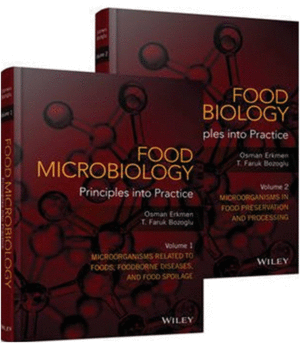
This book covers application of food microbiology principles into food preservation and processing. Main aspects of the food preservation techniques, alternative food preservation techniques, role of microorganisms in food processing and their positive and negative features are covered. Features subjects on mechanism of antimicrobial action of heat, thermal process, mechanisms for microbial control by low temperature, mechanism of food preservation, control of microorganisms and mycotoxin formation by reducing water activity, food preservation by additives and biocontrol, food preservation by modified atmosphere, alternative food processing techniques, and traditional fermented products processing. The book is designed for students in food engineering, health science, food science, agricultural engineering, food technology, nutrition and dietetic, biological sciences and biotechnology fields. It will also be valuable to researchers, teachers and practising food microbiologists as well as anyone interested in different branches of food.
 -5%
-5%
 -5%
-5%
 -5%
-5%
 -5%
-5%
 -5%
-5%
 -5%
-5%
 -5%
-5%
 -5%
-5%
 -5%
-5%
 -5%
-5%