Descuento:
-5%Antes:
Despues:
61,75 €Part 1 1
1 An Introduction to the Admissibility of Expert Scientific Opinion 3
2 Admissibility from the Legal Perspective 20
3 Forensic Science and the Law: The Path Forward 39
4 Scientific Opinion and the Law in Practice 56
Part 2 65
5 Fundamentals of the Interpretation and Evaluation of Scientific Evidence 67
6 Case Studies in Expert Opinion 78
7 Formal Methods for Logical Evaluation 90
8 Case Studies in Probabilistic Opinion 104
9 Cognitive Bias and Expert Opinion 117
Part 3 127
10 The Evaluation of DNA Profile Evidence 129
11 Low Template DNA 151
12 Footwear Marks in Court 169
13 Fingerprints and Finger ]Marks – Identifying Individuals? 189
14 Trace Evidence, Databases and Evaluation 210
15 Firearm and Tool ]Mark Evidence 229
16 Expert Opinion and Evidence of Human Identity 243
17 Questioned Documents 259
18 Bloodstain Pattern Analysis 277
19 Conflicting Expert Opinion: SIDS and the Medical Expert Witness 293
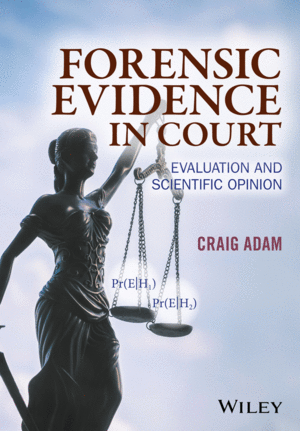
The interpretation and evaluation of scientific evidence and its presentation in a court of law is central both to the role of the forensic scientist as an expert witness and to the interests of justice. This book aims to provide a thorough and detailed discussion of the principles and practice of evidence interpretation and evaluation by using real cases by way of illustration. The presentation is appropriate for students of forensic science or related disciplines at advanced undergraduate and master´s level or for practitioners engaged in continuing professional development activity. The book is structured in three sections. The first sets the scene by describing and debating the issues around the admissibility and reliability of scientific evidence presented to the court. In the second section, the principles underpinning interpretation and evaluation are explained, including discussion of those formal statistical methods founded on Bayesian inference. The following chapters present perspectives on the evaluation and presentation of evidence in the context of a single type or class of scientific evidence, from DNA to the analysis of documents. For each, the science underpinning the analysis and interpretation of the forensic materials is explained, followed by the presentation of cases which illustrate the variety of approaches that have been taken in providing expert scientific opinion.
 -5%
-5%
 -5%
-5%
 -5%
-5%
 -5%
-5%
 -5%
-5%
 -5%
-5%
 -5%
-5%
 -5%
-5%
 -5%
-5%
 -5%
-5%