Descuento:
-5%Antes:
Despues:
71,14 €Chapter 1: The Development of Forensic Toxicology
Chapter 2: The Duties and Responsibilities of Forensic Toxicologists
Chapter 3: Forensic Toxicology Resources
Chapter 4: The Laboratory
Chapter 5: Analytical Strategy
Chapter 6: Sample Handling
Chapter 7: Storage Stability of Analytes
Chapter 8: Analytical Samples
Chapter 9: Sample Preparation
Chapter 10: Methods of Detection, Identification and Quantitation
Chapter 11: Quality Assurance and Quality Control
Chapter 12: Types of Interpretations
Chapter 13: Reports
Chapter 14: Testifying
APPENDICES
Appendix A: Principles of Pharmacokinetics
Appendix B: Principles of Pharmacodynamics
Appendix C: Immunoassays
Appendix D: Toxicogenomics
Appendix E: Famous Cases in Forensic Toxicology
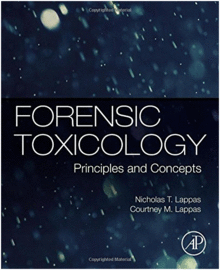
In the last quarter of the 20th century and the first years of the 21st century, there has been a dramatic increase in the literature of forensic toxicology; journals and books have proliferated. There are a number of reasons for this upsurge, including rapid advances in methods of analyses, an improved understanding of the interpretation of post-mortem and ante-mortem analytical results and a better understanding of problems specific to forensic toxicologists, such as post-mortem redistribution and factors influencing drug stability. As significant and important as these advances in the literature of forensic toxicology have been, there has been relatively little literature, other than review articles and portions of a few books, suitable for students beginning their study of forensic toxicology. Many books on the subject attempt to cover the entire topic in a single volume, incorporating the theory of instrumental and immunological analysis, drug disposition, mechanisms of drug action, therapeutic and adverse drug effects (including pathological findings), topics relevant to post-mortem analysis and interpretation as well as chapters on individual drugs of abuse. The result often is either a watered-down presentation of each of these important topics or an encyclopedic volume or volumes far too detailed for the forensic toxicology student. Forensic Toxicology: Principles and Concepts is based upon two graduate courses in forensic toxicology that have been taught by Nicholas T. Lappas for more than 35 years and is intended to present those beginning their study of forensic toxicology with an overview of the largely unchanging principles of the discipline of forensic toxicology. The text will consist of five main sections, each of which will focus on a major tenet of forensic toxicology. Section I will present an introduction to forensic toxicology, covering such topics as the development of forensic toxicology, the roles and functions of forensic toxicologists and important resources utilized by forensic toxicologists. Section II will introduce the beginning toxicology student to the fundamentals of forensic toxicological analysis; topics of focus will include the administration and function of a forensic toxicology laboratory, analytical strategy, the basis of sample selection, collection and preservation, sample types, and methods of analysis. Section III will familiarize the student with the types of interpretations that may be made based on analytical forensic toxicology results, including the types of interpretations and the factors that influence interpretation. Section IV will describe reporting, with topics of focus including laboratory reports, written reports and testimonial reports. Section V will consist of appendices that will cover the principles of pharmacokinetics and pharmacodynamics, immunology and immunological assays, toxicogenomics, and a case book consisting of a compilation of famous and infamous legal cases in which forensic toxicologists have had an integral involvement.
KEY FEATURES
• Significant emphasis on the fundamental principles and concepts of forensic toxicology
• Provides students with an introduction to the core tenets of the discipline, focusing on the concepts, strategies and methodologies utilized by professionals in the field
• Co-authored by a forensic toxicologist with over 40 years of experience, who also teaches the course.
Authors
• Nicholas Lappas The George Washington University, Washington, DC, USA.
• Courtney Lappas Lebanon Valley College, Annville, PA, USA
 -5%
-5%
 -5%
-5%
 -5%
-5%
 -5%
-5%
 -5%
-5%
 -5%
-5%
 -5%
-5%
 -5%
-5%
 -5%
-5%
 -5%
-5%