Descuento:
-5%Antes:
Despues:
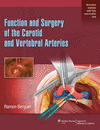
106,70 €1 Anatomy and Function of the Carotid and Vertebral Systems
1.1 The Branches of the Aortic Arch (Supraaortic Trunks) (Image: The branches of the aorta by Frieda Kahlo)
1.1.1 Anatomy and Variations
1.1.2 Clinical Implications of Aortic Arch Anomalies
1.1.3 The Phrenic Nerve and the Subclavian Artery
1.2 The Carotid Artery (Image: Carotid anatomy by Casseri)
1.2.1 Trajectory and Histology
1.2.2 Internal Carotid Artery Aplasia
1.2.3 The Carotid Bifurcation
1.2.4 The Post-Bulbar ICA
1.2.5 Cranial Nerves and Sympathetics in the Carotid Bifurcation Field
1.3 The Vertebral Artery (Image: Willis drawing of the posterior circulation)
1.3.1 The Four Segments
1.3.2 Fenestration and Duplication of the VA
1.3.3 Segment V1: The Extraforaminal Course
1.3.4 Segment V2: Intraspinal Course. Transverse Foramina and Level of Entry of the VA into the Spine
1.3.5 The "Mobile" V3 Segment
1.3.6 The Intracranial V4 Segment
1.3.7 Dominance
1.4 The Circle of Willis (Copper plate drawing by Christopher Wren)
1.5 Persistent Fetal Carotid-Vertebral Anastomosis
2 Differences Between the Carotid and Vertebral Systems
2.1 Divergence vs. Convergence
2.2 Different Pathology
2.3Unequal Clinical Course
3 The pathology
3.1 Imaging the Atherosclerotic Lesion
3.2 Composition of the Plaque
3.3 Fibromuscular Dysplasia
3.4 Carotid and Vertebral Artery Dissection
3.5 Atherosclerotic and Dysplastic Carotid and Vertebral Aneurysms
3.6 Carotid Body Tumors
3.7 Dynamic Compression of the Vertebral Artery (Bow Hunter Syndrome) (Image: Figure of an Archer by Perugino)
3.8 Trauma (Images: Judith by Caravaggio and Duel with cudgels by Goya)
3.9 Arteriovenous Fistula
3.10 Radiation Arteritis
3.11 Vertebral Artery Dissection and Chiropractic Manipulation
3.12 The Invention of Carotidynia
4 Operations on the Supraortic Trunks
4.1 Trans-Thoracic Repairs. The Upper Midsternotomy
4.2 Cervical Bypasses
4.3 Bypass Through the Retropharyngeal Space Across the Midline
4.4 Problems to Avoid
4.5 Operative Risk for SAT Reconstructions (1981-2010)
5 Operations on the Internal Carotid Artery
5.1 Indications for Carotid Surgery
5.2 Positioning and Protective Interventions
5.3 Hypothermia in "Arachnids"
5.4 Access to the Carotid Bifurcation
5.5 Proximal Extension
5.6 Distal Extension
5.7 Retrojugular Access to the ICA at C2
5.8 Distal Extension to C1 (Mandibular Subluxation)
5.9 Posterior Approach to the Infra Temporal Internal Carotid Artery
5.10 Standard Carotid Endarterectomy
5.11 Eversion Endarterectomy
5.12 Technical Errors
5.13 CCA-ICA Bypass
5.14 Carotid Replacement During Resection for Neck Cancer
5.15 Removing a Failed Stent
5.16 Resection of Carotid Body Tumors
5.17 Resection of Carotid Aneurysms
5.18 Nerve Injuries
5.19 Management of Complications after Carotid Surgery
5.20 Operative Risk Data
6 Reconstruction of the Vertebral Artery
6.1 Indications for Surgery
6.2 Proximal Vertebral Reconstruction
6.3 Distal Vertebral Reconstruction
6.3.1 Common Carotid to Distal (V3) Vertebral Bypass
6.3.2 Transposition of External Carotid to Distal (V3) Vertebral Artery
6.3.3 Transposition of Occipital to Distal (V3) Vertebral Artery
6.3.4 Transposition of Distal (V3) VA to Upper Cervical Internal Carotid Artery
6.4 Suboccipital Approach to the VA at C0-C1
6.5 Resection of Vertebral Aneurysms
6.6 Reoperations
6.7 Review of Technical Failures
6.8 Operative Risk Data (1980-2011)
More than a procedural guide, the text represents a guide to decision-making—highlighting individual anatomy, patient screening, selection of procedure, surgical technique, avoidance of pitfalls, and management of potential complications.
- Patient-centered approach highlights patient outcomes in the choice of surgical options.
- Detailed descriptions of vascular anatomy, including anatomic variations, help tailor surgical approaches to each patient.
- Procedural information weighs the pros and cons of open surgery, such as carotid endarterectomy (CEA), versus carotid angioplasty and stents (CAS).
- Comparisons of open and intravascular procedures help readers make informed therapeutic choices for each patient.
Author
Ramon Berguer MD, PhD
Frankel Professor of Vascular Surgery and Professor of Engineering, Samuel and Jean Frankel Cardiovascular Institue, University of Michigan, Ann Arbor, Michigan
 -5%
-5%
 -5%
-5%
 -5%
-5%
 -5%
-5%
 -5%
-5%
 -5%
-5%
 -5%
-5%
 -5%
-5%
 -5%
-5%
 -5%
-5%
 -5%
-5%