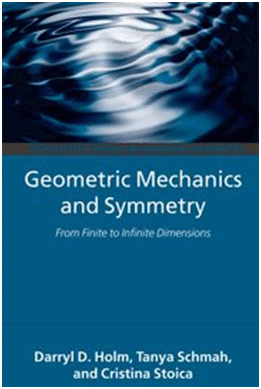
HOLM, D.; SCHMAH, T.; STOICA, C.
Descuento:
-5%Antes:
Despues:
44,95 €Preface
Acknowledgements
PART I
1: Lagrangian and Hamiltonian Mechanics
2: Manifolds
3: Geometry on Manifolds
4: Mechanics on Manifolds
5: Lie Groups and Lie Algebras
6: Group Actions, Symmetries and Reduction
7: Euler-Poincaré Reduction: Rigid body and heavy top
8: Momentum Maps
9: Lie-Poisson Reduction
10: Pseudo-Rigid Bodies
PART II
11: EPDiff
12: EPDiff Solution Behaviour
13: Integrability of EPDiff in 1D
14: EPDiff in n Dimensions
15: Computational Anatomy: contour matching using EPDiff
16: Computational Anatomy: Euler?Poincaré image matching
17: Continuum Equations with Advection
18: Euler?Poincaré Theorem for Geophysical Fluid Dynamics
Bibliography
Classical mechanics, one of the oldest branches of science, has undergone a long evolution, developing hand in hand with many areas of mathematics, including calculus, differential geometry, and the theory of Lie groups and Lie algebras. The modern formulations of Lagrangian and Hamiltonian mechanics, in the coordinate-free language of differential geometry, are elegant and general. They provide a unifying framework for many seemingly disparate physical systems, such as n?particle systems, rigid bodies, fluids and other continua, and electromagnetic and quantum systems.
Geometric Mechanics and Symmetry is a friendly and fast-paced introduction to the geometric approach to classical mechanics, suitable for a one- or two- semester course for beginning graduate students or advanced undergraduates. It fills a gap between traditional classical mechanics texts and advanced modern mathematical treatments of the subject. After a summary of the necessary elements of calculus on smooth manifolds and basic Lie group theory, the main body of the text considers how symmetry reduction of Hamilton's principle allows one to derive and analyze the Euler-Poincaré equations for dynamics on Lie groups.
Additional topics deal with rigid and pseudo-rigid bodies, the heavy top, shallow water waves, geophysical fluid dynamics and computational anatomy. The text ends with a discussion of the semidirect-product Euler-Poincaré reduction theorem for ideal fluid dynamics.
A variety of examples and figures illustrate the material, while the many exercises, both solved and unsolved, make the book a valuable class text.
Features
• Modern, relevant examples of applications
• Draws parallels between finite and infinite dimensional concepts
• Ideal as a teaching text
• Contains numerous illustrations and exercises
• Full proofs are given for all main theorems
Authors
• Darryl D. Holm, Professor, Mathematics Department, Imperial College London.
• Tanya Schmah, Department of Computer Science, University of Toronto and Department of Mathematics, Macquarie University, Australia.
• Cristina Stoica, Department of Mathematics, Wilfrid Laurier University, Canada
 -5%
-5%
 -5%
-5%
 -5%
-5%
 -5%
-5%
 -5%
-5%
 -5%
-5%
 -5%
-5%
 -5%
-5%
 -5%
-5%
 -5%
-5%