Descuento:
-5%Antes:
Despues:
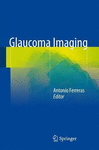
158,07 €This atlas offers a truly comprehensive update on the use of imaging technologies for the diagnosis and follow-up of glaucoma. In addition to standard automated perimetry, gonioscopy, fundus photography, and stereophotography, other advanced, high-resolution methods for imaging the eye in glaucoma are explained in detail, including ultrasound biomicroscopy, confocal scanning laser ophthalmoscopy, scanning laser polarimetry, and spectral domain optical coherence tomography. The role of the various tests and the keys to optimizing their use in clinical practice are detailed with the aid of high-quality figures in order to enable the reader to achieve the best possible performance when applying these tools.
The risk of developing visual disability and blindness as a consequence of glaucoma varies widely among affected individuals. Personalized testing strategies and tailored therapeutic interventions are required to effectively reduce visual impairment due to glaucoma. Glaucoma Imaging will assist residents, researchers, and clinicians in improving their ability to understand and integrate the information obtained using traditional techniques with the reports provided by computer-assisted image instruments.
Feature:
- Offers comprehensive guidance on use of imaging technologies for diagnosis and follow-up
- Explains the roles of both traditional and advanced imaging techniques
- Identifies the keys to optimizing use of the different methods
About the authors
Antonio Ferreras, MD, PhD, is a Consultant Ophthalmologist who works at the Miguel Servet University Hospital, Zaragoza, Spain and the Aragon Health Sciences Institute, University of Zaragoza. He has been an Associate Professor at the University of Zaragoza since 2007. Until 2010 he worked as a glaucoma and cataract surgeon, and he is currently a vitreoretinal and cataract surgeon. Dr. Ferreras has been involved in numerous clinical trials and his research has included the diagnosis of glaucoma by means of high-definition optical coherence tomography and scanning laser polarimetry with enhanced corneal compensation. He is the recipient of an International Ophthalmologist Education Award (2009) and an Achievement Award (2013) from the American Academy of Ophthalmology. Dr. Ferreras is a member of the editorial board of Case Reports in Ophthalmological Medicine and a member of the International Journal of Ophthalmology Expert Board. He has been guest editor for a Journal of Ophthalmology special edition on “Different aspects in different glaucomas” (2010-11) and for the BioMed Research International special issue on “Advances in imaging technologies for evaluating the retina and the optic disc” (2014). He is the author of more than 80 peer-reviewed publications.
Table of contents (12 chapters)
1.Standard Automated Perimetry
2.Gonioscopy
3.Measurement of Intraocular Pressure with Goldmann Applanation Tonometry, Dynamic-Contour Tonometry, and Ocular Response Analyzer
4.Ultrasound Biomicroscopy in Glaucoma
5.Retrobulbar Ocular Blood Flow Evaluation in Open-Angle Glaucoma
6.Optic Nerve Head Assessment and Retinal Nerve Fiber Layer Evaluation
7.Confocal Scanning Laser Ophthalmoscopy
8.Detection of Glaucoma Using Scanning Laser Polarimetry
9.Optical Coherence Tomography
10.Measuring Hemoglobin Levels in the Optic Nerve Head for Glaucoma Management
11.Structure and Function Relationship in Glaucoma
12.Assessment of Structural Glaucoma Progression
 -5%
-5%
 -5%
-5%
 -5%
-5%
 -5%
-5%
 -5%
-5%
 -5%
-5%
 -5%
-5%
 -5%
-5%
 -5%
-5%
 -5%
-5%