Descuento:
-5%Antes:
Despues:
152,00 €1 Graptolites: An Introduction 1
2 Biological Affinities 15
3 Construction of Graptolite Tubaria 31
4 Paleoecology of the Pterobranchia 50
5 Graptolites as Rock Components 76
6 Graptolites and Stratigraphy 94
7 Taxonomy and Evolution 111
8 Bound to the Sea Floor: The Benthic Graptolites 124
9 The Planktic Revolution 139
10 Early Ordovician Diversity Burst 153
11 The Biserial Graptolites 181
12 The Retiolitid Graptolites 207
13 The Monograptids 221
14 Collection, Preparation and Illustration of Graptolites 244
15 History of Graptolite Research 254
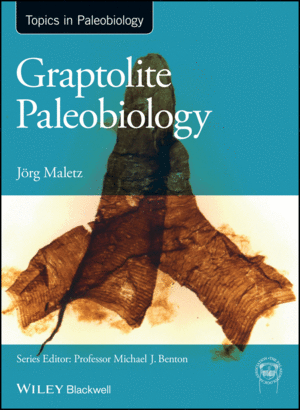
The graptolites constitute one of the geologically most useful taxonomic groups of fossils for dating rock successions, understanding paleobiogeography and reconstructing plate tectonic configurations in the Lower Palaeozoic. Graptolites were largely planktic, marine organisms, and as one of the first groups that explored the expanses of the worlds oceans are vital for understanding Palaeozoic ecology.á They are the best and often the only fossil group for dating Lower Palaeozoic rock successions precisely. Thousands of taxa have been described from all over the planet and are used for a wide variety of geological and palaeontological (biological) research topics. The recent recognition of the modern pterobranch Rhabdopleura as a living benthic graptolite enables a much better understanding and interpretation of the fossil Graptolithina. The Graptolithina have been the topic of two editions of the Treatise (Bulman, 1955, 1970), both of which are now long out-dated and do not provide even the basic information for a scientific understanding of this fascinating fossil group.á About 600 genera including several thousand species have been described, of which only a handful belong to extant taxa, indicating the importance of fossil faunas and our need to understand the interconnection of fossil (Palaeozoic) taxa and their modern (extant) relatives. In the decades since the latest edition of the Graptolite Treatise (Bulman 1970), the enormous increase of knowledge on this group of organisms has never been synthesised in a compelling and coherent way, and information is scattered in scientific publications and difficult to sort through.
Author Information
Jörg Maletz is a researcher based at the Freie Universität Berlin, Germany.
 -5%
-5%
 -5%
-5%
 -5%
-5%
 -5%
-5%
 -5%
-5%
 -5%
-5%
 -5%
-5%
 -5%
-5%
 -5%
-5%
 -5%
-5%
 -5%
-5%