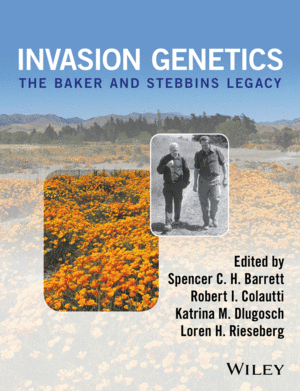
BARRET, S.; COLAUTTI, R.I.; DLUGOSCH, K.M.
Descuento:
-5%Antes:
Despues:
67,88 €PART 1 EVOLUTIONARY ECOLOGY, 19
Introduction, 21
2 The influence of numbers on invasion success, 25
3 Characteristics of successful alien plants, 40
4 Evolution of the mating system in colonizing plants, 57
5 The population biology of fungal invasions, 81
6 Contemporary evolution during invasion: evidence for differentiation, natural selection, and local adaptation, 101
7 Exotics exhibit more evolutionary history than natives: a comparison of the ecology and evolution of exotic and native anole lizards, 122
8 Causes and consequences of failed adaptation to biological invasions: the role of ecological constraints, 139
Discussion, 153
PART 2 EVOLUTIONARY GENETICS, 159
Introduction, 161
9 Evolution of phenotypic plasticity in colonizing species, 165
10 Chromosome inversions, adaptive cassettes and the evolution of species’ ranges, 175
11 The distribution of genetic variance across phenotypic space and the response to selection, 187
12 Information entropy as a measure of genetic diversity and evolvability in colonization, 206
13 Expansion load: recessive mutations and the role of standing genetic variation, 218
14 The devil is in the details: genetic variation in introduced populations and its contributions to invasion, 232
Discussion, 253
PART 3 INVASION GENOMICS, 261
Introduction, 263
15 Genetic reconstructions of invasion history, 267
16 Comparative genomics in the Asteraceae reveals little evidence for parallel evolutionary change in invasive taxa, 283
17 The role of climate adaptation in colonization success in Arabidopsis thaliana, 300
18 A genetic perspective on rapid evolution in cane toads (Rhinella marina), 313
19 Epigenetics of colonizing species? A study of Japanese knotweed in Central Europe, 328
Discussion, 341
20 What we still don’t know about invasion genetics, 346
Index, 371
Invasion Genetics: the Baker ´>This volume covers a range of topics concerned with the evolutionary biology of invasion including: phylogeography and the reconstruction of invasion history; demographic genetics; the role of stochastic forces in the invasion process; the contemporary evolution of local adaptation; the significance of epigenetics and transgenerational plasticity for invasive species; the genomic consequences of colonization; the search for invasion genes; and the comparative biology of invasive species. A wide diversity of invasive organisms are discussed including plants, animals, fungi and microbes.
 -5%
-5%
 -5%
-5%
 -5%
-5%
 -5%
-5%
 -5%
-5%
 -5%
-5%
 -5%
-5%
 -5%
-5%
 -5%
-5%
 -5%
-5%