Descuento:
-5%Antes:
Despues:
44,65 ۥ PART ONE: ANTHROPOLOGY: WHAT IS A HUMAN BEING?
1: We are dialogue
2: The primacy of relation
3: The cradle of the dialogic principle
4: The life-world of the I-You relation
5: The innate You: the basic package
6: The dialogue with alterity: narratives and the dialectic of identity
7: A closer look into alterity: eccentricity
8: The Uncanny and the secretely familiar double
9: Epiphanies of alterity: drive
10: Habitus: the emergence of alterity in social situations
11: Emotions: the person in between moods and affects
12: A closer look at moods and affects: intentionality and temporality
13: Emotions and the dialectic of narrative identity
14: Alterity and the recoil of one's actions
15: Alterity and the other person: the anatomy of recognition
16: The basic need for recognition
17: A logic for recognition: heterology
18: An anthropology of non-recognition
• PART TWO: PSYCHOPATHOLOGY: WHAT IS MENTAL DISORDER?
19: First steps toward the person-centered, dialectical model of mental disorders
20: What is a symptom?
21: The truth about symptoms
22: Symptom as cypher
23: Conflicting values: the case with post partum depression
24: The body as alterity: the case with gender dysphoria
25: The trauma of non-recognition
26: Erotomia and idolatrous desire
27: Depression and the idealization of common sense desire
28: Borderline and the glorification of a thrilled flesh
29: Schizophrenia and the disembodiment of desire
• PART THREE: THERAPY: WHAT IS CARE?
30: The portrait of the clinician as a globally minded citizen
31: The chiasm
32: The P.H.D. method
33: Empathy and beyond
34: Second-order empathy
35: Unfolding
36: Position-taking
37: Responsibility
38: Perspective-taking
40: What is a story?
41: Personal life-history
42: Intimacy
• EPILOGUE: DIALECTIC METHOD AND DIALOGUE
The field of psychiatry has long struggled with developing models of practice; most underemphasize the interpersonal aspects of clinical practice.
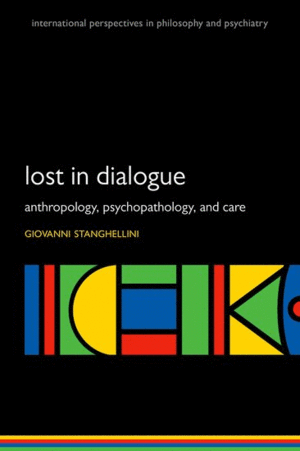
This essay is unique in putting intersubjectivity front and center. It is an attempt to provide a clinical method to re-establish the fragile dialogue of the soul with oneself and with others. Throughout, the book builds on the assumption that to be human means to be in dialogue. It uses dialogue as a unitary concept to address three essential issues for clinical practice: 'What is a human being?', 'What is mental pathology'?, and 'What is care?'. To be human - it is argued - means to be in dialogue with oneself and with other persons. Thus, mental pathology is the interruption of this dialogue - both of the person with the alterity that inhabits them, and with the alterity incarnated in other persons. Therefore, therapy is a dialogue with a method whose aim is to re-enact one's interrupted dialogue with alterity.
Lost in Dialogue provides a method to approximate the Other, to understand its experiences, actions, and in general, understand the world in which it lives.
Features
• Brings together philosophy and clinical practice to consider three fundamental questions - 'What is a human being?', 'What is mental disorder?', and 'What is care?'
• Provides a method to approximate the Other, to understand its experiences, actions and in general the world it lives in. It describes the steps to achieve this knowledge of the Other's world
• Presents an account of care as the kind of dialogic practice that can be derived from philosophical and psychopathological premises
Author
Giovanni Stanghellini, MD and Dr. Phil. honoris causa, psychiatrist and psychotherapist, is professor of Dynamic Psychology and Psychopathology at <"G. d'Annunzio>" University (Chieti, Italy) and Profesor Adjuncto <"D. Portales>" University (Santiago, Chile). He chairs the World Psychiatric Association (WPA) Section on Psychiatry and the Humanities, and the Association of European Psychiatrists (EPA) Section on Philosophy and Psychiatry. He is also founding chair of the Scuola di Psicoterapia e Fenomenologia Clinica (Florence). Among his books, all published by Oxford University Press: Nature and Narrative (co-edited with KWM Fulford, K. Morris and JZ Sadler, OUP 2003), Disembodied Spirits and Deanimated Bodies. The Psychopathology of Common Sense (OUP 2004), Emotions and Personhood (with R. Rosfort, OUP 2013), One Hundred Years of Karl Jaspers' General Psychopathology (co-edited with T. Fuchs, OUP 2013) and the Oxford Handbook of Philosophy and Psychiatry
 -5%
-5%
 -5%
-5%
 -5%
-5%
 -5%
-5%
 -5%
-5%
 -5%
-5%
 -5%
-5%
 -5%
-5%
 -5%
-5%
 -5%
-5%