Descuento:
-5%Antes:
Despues:
80,75 €Preface xi
Peter S. Ozsv´ath and Tomasz S. Mrowka
In roduction 1
1. The subject 3
2. The PCMI Graduate Summer School 3
3. Acknowledgments 5
John Milnor
Fifty Years Ago: Topology of Manifolds in the 50’s and 60’s 7
1. 3-dimensional manifolds 9
2. Higher dimensions 10
3. Why are higher dimensions sometimes easier? 14
4. Questions from the audience 15
5. Bibliography 18
Cameron Gordon
Dehn Surgery and 3-Manifolds 21
Introduction 23
Lecture 1. 3-manifolds and knots 25
1.1. 3-manifolds 25
1.2. Knots 27
1.3. Exercises 29
Lecture 2. Dehn surgery 31
2.1. Overview 31
2.2. Framed surgery on knots on surfaces 34
2.3. Exercises 35
Lecture 3. Exceptional Dehn surgeries 37
3.1. Exceptional surgeries 37
3.2. Lens space surgeries 37
3.3. Seifert fiber space surgeries 38
3.4. Toroidal surgeries 39
3.5. Knots in solid tori 39
3.6. Exercises 41
Lecture 4. Rational tangle filling 43
4.1. Dehn filling 43
4.2. Tangles 43
4.3. Tangles with non-simple double branched covers 47
4.4. Example: the Whitehead link 47
4.5. Exercises 50
Lecture 5. Examples of exceptional Dehn fillings 51
5.1. Some examples 51
5.2. Chain links 54
5.3. Simplicity of the double branched cover 56
5.4. Exercises 57
Lecture 6. Classification of some exceptional fillings 59
6.1. Some classification theorems 59
6.2. Seifert fiber spaces 65
6.3. Methods of proof; non-integral toroidal surgeries 65
Bibliography 69
David Gabai
Hyperbolic Geometry and 3-Manifold Topology 73
Introduction 75
1. Topological tameness; examples and foundations 76
2. Background material for hyperbolic 3-manifolds 79
3. Shrinkwrapping 82
4. Proof of Canary’s theorem 86
5. The tameness criterion 88
6. Proof of the tameness theorem 96
Bibliography 101
John W. Morgan (notes by Max Lipyanskiy)
Ricci Flow and Thurston’s Geometrization Conjecture 105
Introduction 107
Lecture 1. Statement of Thurston’s geometrization conjecture 109
1. Prime decomposition 109
2. Examples of geometric manifolds 109
3. Thurston geometrization conjecture 111
Lecture 2. Basics of Ricci flow 113
1. Conjectures on the geometric structure of 3-manifolds 113
2. Review of the Riemann curvature tensor 114
3. The Ricci flow equation 114
4. Examples: Einstein manifolds, Ricci solitons, and gradient shrinking
solitons 115
5. Maximum principle 116
6. Consequences of the maximum principle 117
Lecture 3. Blow-up limits and ?-non-collapsed solutions 119
1. Definition of blow-up limit 119
2. Criteria for existence of blow-up limits 119
3. L-geodesics and reduced volume 120
4. Non-collapsing 122
5. Curvature bounds 122
Lecture 4. Structure of ?-solutions and canonical neighborhoods 123
1. Gradient shrinking solitons 123
2. Classification of gradient shrinking solitons 124
3. ?-non-collapsed solutions 124
4. Canonical neighborhoods 124
5. Existence of canonical neighborhoods for ?-solutions 125
6. Canonical neighborhoods for Ricci flows 125
Lecture 5. Structure of regions of large curvature and surgery 127
1. Canonical neighborhoods for regions of high curvature 127
2. Global versions of tubes and caps 127
3. Global structure of the regions of large curvature 129
4. The structure at the singular time 129
5. The surgery process 129
6. Auxiliary Ricci flow to glue in 130
Lecture 6. Ricci flow with surgery and finite-time extinction 131
1. Ricci flow with surgery 131
2. Geometrization 132
Bibliography 137
Marta Asaeda and Mikhail Khovanov
Notes on Link Homology 139
Introduction 141
Lecture 1. A braid group action on a category of complexes 143
1. Path rings 143
2. Zigzag rings An 144
3. A functor realization of the Temperley-Lieb algebra 145
4. The homotopy category of complexes 147
5. Braid group representation 148
Lecture 2. More on braid group actions 151
1. Invertibility of Ri 151
2. Braid group action on complexes of projective modules Pi and topology
of plane curves 151
3. Reduced Burau representation 154
Lecture 3. A Categorification of the Jones polynomial 157
1. The Jones polynomial 157
2. Categorification and a bigraded link homology theory 158
3. Properties and examples 164
Lecture 4. Flat tangles and bimodules 169
1. Two-dimensional TQFTs and Frobenius algebras 169
2. Algebras Hn 171
3. Flat tangles and their cobordisms 173
Lecture 5. A homological invariant of tangles and tangle cobordisms 177
1. An invariant of tangles 177
2. Tangle cobordisms 179
3. Equivariant versions and applications 181
Lecture 6. Categorifications of the HOMFLY-PT polynomial 185
1. The HOMFLY-PT polynomial and its generalizations 185
2. Hochschild homology 186
3. A categorification of the HOMFLY-PT polynomial 189
Bibliography 193
Zolt´an Szab´o
Lecture Notes on Heegaard Floer Homology 197
Introduction. 199
Acknowledgments. 199
1. Three-manifolds and Heegaard decompositions. 199
1.1. Basic examples. 199
1.2. Heegaard decompositions. 200
1.3. Exercises for Section 1. 202
2. Heegaard diagrams. 202
2.1. Handle decompositions. 202
2.2. Attaching circles. 203
2.3. Examples. 203
2.4. Heegaard moves. 204
2.5. Exercises for Section 2. 205
3. Morse functions. 205
3.1. Exercises for Section 3. 207
4. Symmetric products and generators. 207
4.1. Heegaard generators. 208
4.2. Symmetric products. 208
4.3. Whitney disks. 209
4.4. An obstruction for Whitney disks. 210
4.5. More on homotopy classes and shadows. 210
4.6. Exercises for Section 4. 211
5. Pointed diagrams. 212
5.1. Admissible diagrams. 213
5.2. Two-pointed Heegaard diagrams. 213
5.3. Chain-complexes for pointed Heegaard diagrams. 213
5.4. Chain complexes for knots. 214
5.5. Exercises for Section 5. 214
6. Holomorphic disks. 214
6.1. A mod 2 invariant. 215
6.2. Properties of the Maslov index. 216
6.3. Exercises for Section 6. 217
7. A local formula for the Maslov index. 217
7.1. Exercises for Section 7. 218
8. The chain complex. 218
8.1. Exercises for Section 8. 220
9. Generators and spin-c structures. 221
9.1. Exercises for Section 9. 222
10. Further constructions. 222
10.1. The construction of HF +(Y, s). 222
10.2. Orientations. 223
10.3. Knot Floer homology. 223
10.4. Computations. 225
11. Problems. 225
Bibliography 226
John Etnyre
Contact Geometry in Low Dimensional Topology 229
1. Introduction 231
2. Contact structures and foliations 233
3. From foliations to contact structures 242
3.1. Part 2 of the proof of Theorem 3.1 244
3.2. Part 1 of the proof of Theorem 3.1 246
4. Taut foliations and symplectic fillings 253
5. Symplectic handle attachment and Legendrian surgery 255
6. Open book decompositions and symplectic caps 258
Bibliography 262
Ronald Fintushel and Ronald J. Stern
Six Lectures on Four 4-Manifolds 265
Introduction 267
Lecture 1. How to construct 4-manifolds 269
1. Algebraic topology 270
2. Techniques used for the construction of simply connected smooth and
symplectic 4-manifolds 270
3. Some examples: Horikawa surfaces 271
4. Complex surfaces 273
5. More symplectic manifolds 273
Lecture 2. A user’s guide to Seiberg-Witten theory 275
1. The set-up 275
2. The equations 277
3. Adjunction Inequality 278
4. K¨ahler manifolds 279
5. Blowup formula 279
6. Gluing formula 279
7. Seiberg-Witten invariants of elliptic surfaces 280
8. Nullhomologous tori 280
9. Seiberg-Witten invariants for log transforms 281
Lecture 3. Knot surgery 283
1. The knot surgery theorem 283
2. Proof of knot surgery theorem: the role of nullhomologous tori 284
Lecture 4. Rational blowdowns 291
1. Configurations of spheres and associated rational balls 291
2. Effect on Seiberg-Witten invariants 293
3. Taut configurations 294
Lecture 5. Manifolds with b+ = 1 297
1. Seiberg-Witten invariants 297
2. Smooth structures on blow-ups of CP2 299
Lecture 6. Putting it all together: The geography and botany of 4-manifolds 305
1. Existence: the geography problem 305
2. Uniqueness: the botany problem 307
3. Horikawa surfaces: how to go from one deformation type to another 308
4. Manifolds with c = 9?h : a fake projective plane 309
5. Small 4-manifolds 310
6. What were the four 4-manifolds? 311
Bibliography 313
A co-publication of the AMS and IAS/Park City Mathematics Institute
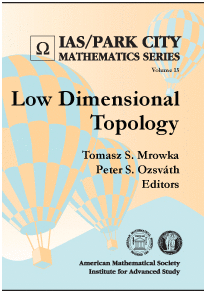
Low-dimensional topology has long been a fertile area for the interaction of many different disciplines of mathematics, including differential geometry, hyperbolic geometry, combinatorics, representation theory, global analysis, classical mechanics, and theoretical physics. The Park City Mathematics Institute summer school in 2006 explored in depth the most exciting recent aspects of this interaction, aimed at a broad audience of both graduate students and researchers.
The present volume is based on lectures presented at the summer school on low-dimensional topology. These notes give fresh, concise, and high-level introductions to these developments, often with new arguments not found elsewhere. The volume will be of use both to graduate students seeking to enter the field of low-dimensional topology and to senior researchers wishing to keep up with current developments. The volume begins with notes based on a special lecture by John Milnor about the history of the topology of manifolds. It also contains notes from lectures by Cameron Gordon on the basics of three-manifold topology and surgery problems, Mikhail Khovanov on his homological invariants for knots, John Etnyre on contact geometry, Ron Fintushel and Ron Stern on constructions of exotic four-manifolds, David Gabai on the hyperbolic geometry and the ending lamination theorem, Zoltán Szabó on Heegaard Floer homology for knots and three manifolds, and John Morgan on Hamilton's and Perelman's work on Ricci flow and geometrization.
Authors
• Tomasz S. Mrowka: Massachusetts Institute of Technology, Cambridge, MA,
• Peter S. Ozsváth: Columbia University, New York, NY
 -5%
-5%
 -5%
-5%
 -5%
-5%
 -5%
-5%
 -5%
-5%
 -5%
-5%
 -5%
-5%
 -5%
-5%
 -5%
-5%
 -5%
-5%