Descuento:
-5%Antes:
Despues:
52,25 €Preface vii
Chapter 1. Introduction 1
1.1. Modeling Biological Development 1
1.2. Early Stages: A Brief Survey 2
1.3. An Example: Formation of the Blastocoel 3
Chapter 2. Catastrophe Theory 13
2.1. Basic Elements 13
2.2. Categorization and Applications 19
2.3. Global Implications of Local Structure 27
Chapter 3. Pattern Formation 35
3.1. Biological Pattern 35
3.2. Reaction-Diffusion Systems: Inception of Inhomogeneity 38
3.3. Inhomogeneous Steady State 47
3.4. Multistable Regimes 53
3.5. Some Applications 61
Chapter 4. Differential Adhesion and Morphogenesis 67
4.1. Cell Sorting by Differential Adhesion 68
4.2. Rheology of Cell Aggregates 74
4.3. Elements of Morphodynamics 81
Chapter 5. The Origins of Movement 89
5.1. Chemistry and Geometry of Adhesion 89
5.2. Equilibrium and Stability 98
5.3. Gastrulation in Amphibians 101
5.4. Cell Motion in Thin Layers 110
5.5. Dynamics of Adhesion-Driven Structure 117
5.6. Cell-Substrate Adhesion 121
5.7. Imaginal Disc Evagination 123
Chapter 6. Chemotaxis 125
6.1. Initiation of Slime Mold Aggregation 125
6.2. Other Aspects of Chemotaxis 129
Chapter 7. Cell Proliferation 137
7.1. Homogeneous Population 137
7.2. Environmental Control of Cell Division 151
7.3. Stem Cell Dynamics 160
7.4. Sol-Gel Transformation 163
7.5. Mesoscopic Viewpoint 165
7.6. Turing Dynamical Resolution 169
Chapter 8. Somite Formation in Vertebrates 173
8.1. Elementary Oscillations 173
8.2. Time-Delay Oscillators 176
8.3. Biochemical Entrainment and Biochemical Waves 179
8.4. Clock, Wavefront, and Somite Condensation 185
Chapter 9. Compartments 191
9.1. The Evidence and Its Implications 191
9.2. Nonlinear Theory of Compartmentalization 198
Chapter 10. Segmentation of Insect Embryos 209
10.1. Prototypical Reaction-Diffusion: One Component 209
10.2. Prepattern Activation 215
10.3. Further Aspects of Reaction-Diffusion 221
10.4. Pattern Under Growth: Chick Limb Bud 225
10.5. Insect Imaginal Disc 227
Supplementary Notes 231
Chapter 2 231
Chapter 3 231
Chapters 4 and 5 233
Chapter 6 233
Chapters 7 and 8 234
Chapters 9 and 10 234
Bibliography 237
Index 245
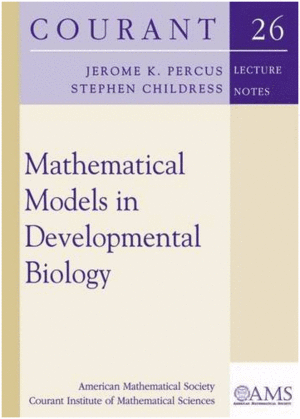
The path from relatively unstructured egg to full organism is one of the most fascinating trajectories in the biological sciences. Its complexity calls for a very high level of organization, with an array of subprocesses in constant communication with each other. These notes introduce an interleaved set of mathematical models representative of research in the last few decades, as well as the techniques that have been developed for their solution. Such models offer an effective way of incorporating reliable data in a concise form, provide an approach complementary to the techniques of molecular biology, and help to inform and direct future research.
Authors
• Jerome K. Percus: New York University, Courant Institute of Mathematical Sciences, New York, NY,
• Stephen Childress: New York University, Courant Institute of Mathematical Sciences, New York, NY
 -5%
-5%
 -5%
-5%
 -5%
-5%
 -5%
-5%
 -5%
-5%
 -5%
-5%
 -5%
-5%
 -5%
-5%
 -5%
-5%
 -5%
-5%