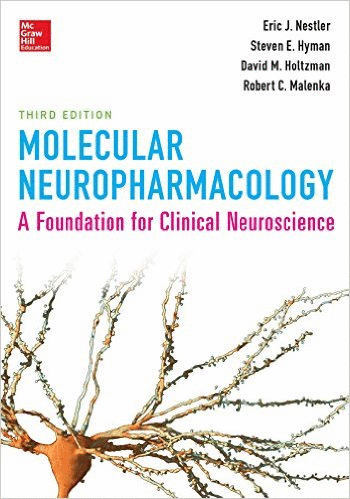
NESTLER, E.; HYMAN, S.; MALENKA, R.
Descuento:
-5%Antes:
Despues:
64,78 €Molecular Neuropharmacology first reviews the fundamental biochemistry of the functioning nervous system and then describes how nerve cells communicate with one another through numerous types of neurotransmitters involving amino acids, monoamines, neuropeptides, and neurotrophic factors, among several others.
The neuropharmacology and neural circuits that underlie complex behaviors as well as major neural disorders are also discussed as are the drugs used to treat those conditions. In the final section, the authors use the concepts presented in the first two sections to explain how irregularities in the biochemistry of neuronal interactions can lead to a wide array of clinical manifestations.
FEATURES
- NEW chapter on neuroinflammation
- All chemical structure illustrations have been redrawn and improved
- Fully updated to reflect the latest breakthroughs and new drugs
- The most well-written and easily understood work on the subject
- More than 300 full-color illustrations!
Author comments
- Eric J. Nestler, MD, PhD (New York, NY) Nash Family Professor of Neuroscience; Chairman, Department of Neuroscience and Director of the Mount Sinai Brain Institute, Mount Sinai School of Medicine.
- Steven E. Hyman, MD (Cambridge, MA) Director, Stanley Center for Psychiatric Research, Broad Institute; Distinguished Service Professor of Stem Cell and Regenerative Biology Harvard University.
- Robert C. Malenka, MD, PhD (Palo Alto, CA) Nancy Friend Pritzker Professor of Psychiatry and Behavioral Sciences; Director, Nancy Friend Pritzker Laboratory, Stanford University School of Medicine.
- David M. Holtzman, MD (St. Louis, MO) Andrew B. and Gretchen P. Jones Professor of Neurology Charlotte and Paul Hagemann Professor of Neurology Chairman, Department of Neurology Professor, Molecular Biology and Pharmacology Washington University School of Medicine in St. Louis Neurologist-in-Chief, Barnes-Jewish Hospital.
Table of contents
I. Fundamentals of Neuropharmacology
1. Basic Principles of Neuropharmacology
2. Cellular Basis of Communication
3. Synaptic Transmission
4. Signal Transcuction in the Brain
II. Neural Substrates of Drug Action
5. Excitatory and Inhibitory Amino Acids
6. Monoamines, Acetylcholine, and Orexin
7. Neuropeptides
8. Atypical Neurotransmitters Neuropharmacology of Neural Systems and Disorders
9. Autonomic Nervous System
10. Neural and Neuroendocrine Control of Internal Mileau
11. Pain
12. Neuroinflammation
13. Sleep and Arousal
14. Cognitive Function and Behavior
15. Mood and Emotion
16. Reinforcement and Addiction
17. Schizophrenia and Other Psychoses
18. Neurodegeneration
19. Seizures
20. Stroke and Migraine
 -5%
-5%
 -5%
-5%
 -5%
-5%
 -5%
-5%
 -5%
-5%
 -5%
-5%
 -5%
-5%
 -5%
-5%
 -5%
-5%
 -5%
-5%