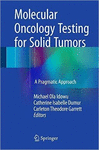
IDOWU, M.O.; DUMUR, C.I.; GARRETT, C.T.
Descuento:
-5%Antes:
Despues:
167,95 €Table of contents (21 chapter)
1.Molecular Biology Basics in the “Omics” Era: Genes to Proteins
2.Molecular Biology Basics in the “Omics” Era: Cancer Pathology
3.Standard Nomenclature: Why Bother?
4.Pathologists’ Roles in Molecular Oncology Testing of Solid Tumors
5.Molecular Methodologies
6.General Principles of Validating a Molecular Test
7.Application of Chromosomal Microarray
8.Lung and Mediastinal Tumors
9.Breast Tumors
10.Head and Neck Tumors
11.Thyroid and Parathyroid Tumors
12.Gastrointestinal and Pancreatobiliary Tumors
13.Soft Tissue Tumors
14.Genitourinary System Tumors
15.Gynecologic Tumors
16.Central Nervous System Tumors
17.Molecular Oncologic Testing of Skin and Adnexa Tumors
18.Lymphoma and Lymphoproliferative Disorders
19.Common Hereditary Cancer Syndromes
20.Quality Control and Quality Assurance in Solid Tumor Molecular Genetic Testing
21.Coding and Reimbursement
Familiarity with and understanding molecular testing is becoming imperative for practicing physicians, especially pathologists and oncologists given the current explosion of molecular tests for diagnostic, prognostic and predictive indications.
Molecular Oncology Testing for Solid Tumors is designed to present an up to date practical approach to molecular testing in a easy to understand format. Emphasis is placed on quality assurance (pre-analytic, analytic and post-analytic) and test interpretation, including but not limited to: the important role of pathologists in ensuring specimen adequacy for molecular testing; factors to consider in choosing platforms for molecular assays; advantages and limitations inherent to common assays/platforms that pathologists need to communicate effectively with clinicians; the importance of required quality assurance measures to ensure accurate / reproducible results; pitfalls in test interpretation (including different types of artifacts that may lead to False Positive or False Negative interpretations); test reporting using standard nomenclature; review of the current and future potential utility of next-generation sequencing in oncology.
All chapters are written by pathologists and clinicians experienced in practical applications of molecular tests for solid tumors. The uniqueness of this textbook is the use of a standardized template for each of the molecular tests being discussed followed by a discussion of relevant quality assurance issues to ensure focused and efficient presentation of information. This will enable readers to easily understand the Order, Report and Evaluate (ORE) process of molecular tests. Lastly, summary tables of all the molecular assays and mutations discussed in the text are provided as an appendix for quick reference. For readers interested in more detailed information, a link to websites where additional information can be obtained is provided.
 -5%
-5%
 -5%
-5%
 -5%
-5%
 -5%
-5%
 -5%
-5%
 -5%
-5%
 -5%
-5%
 -5%
-5%
 -5%
-5%
 -5%
-5%