Descuento:
-5%Antes:
Despues:
180,50 €Preface
1. Introduction to lung pathology
2. Granulomatous lung disease
3. Infections of the lung, non-granulomatous
4. Predominantly airspace abnormalities
5. Predominantly interstitial lung disease
6. Non-neoplastic lung nodules and masses
7. Cysts and cyst-like lesions of the lung in children and adults
8. Pigment-laden macrophages in the lung
9. Pathologic abnormalities in the airways (bronchi or bronchioles)
10. Pathologic abnormalities of pulmonary blood vessels
11. Lung transplant pathology
Index.
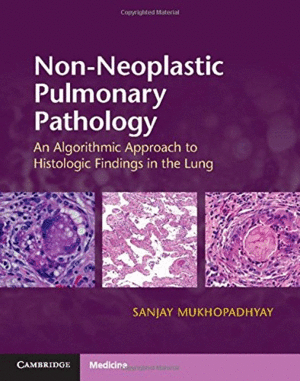
This generously illustrated textbook is a simple guide to the pathologic diagnosis of 'medical' lung disease, written by an expert, subspecialty-trained pulmonary pathologist. General surgical pathologists and pathology residents will find it accessible and full of practical pearls that can be used in real-life situations. The algorithms in this book provide a glimpse into the thought process of a subspecialist. They start with an abnormal histologic finding, and take the reader step by step to the correct diagnosis. Unlike most pathology textbooks, diseases are grouped on the basis of pathologic findings rather than etiology, mirroring the actual practice of surgical pathology. Another novel feature of this book is that it provides actual examples of pathology reports for each disease. Pathologists will find this book tremendously helpful when faced with difficult cases of interstitial lung disease or lung granulomas. It should be part of every surgical pathologist's library.
Key Features
• Key microscopic findings and variable findings are presented in separate sections to enable the reader to quickly determine which findings are essential for a pathologic diagnosis
• Side-by-side photomicrographs of similar entities provide a visual guide to help differentiate between lung diseases with similar histologic findings
• Algorithms with key histologic findings simplify the daunting task of approaching pathologic findings with a broad differential diagnosis
• Includes a glossary of common terms used in lung pathology
Author
Sanjay Mukhopadhyay, Cleveland Clinic, Ohio
Sanjay Mukhopadhyay is Staff Pathologist at the Department of Pathology, Cleveland Clinic, Cleveland, OH, USA.
 -5%
-5%
 -5%
-5%
 -5%
-5%
 -5%
-5%
 -5%
-5%
 -5%
-5%
 -5%
-5%
 -5%
-5%
 -5%
-5%
 -5%
-5%