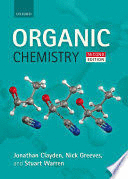
JONATHAN CLAYDEN; NICK GREEVES; STUART WARREN
Descuento:
-5%Antes:
Despues:
63,65 €1: What is organic chemistry?
2: Organic structures
3: Determining organic structures
4: Structure of molecules
5: Organic reactions
6: Nucleophilic addition to the carbonyl group
7: Delocalization and conjugation
8: Acidity, basicity, and pKa
9: Using organometallic reagents to make C-C bonds
10: Nucleophilic substitution at the carbonyl group
11: Nucleophilic substitution at C=O with loss of carbonyl oxygen
12: Equilibria, rates and mechanisms
13: 1H NMR: Proton nuclear magnetic resonance
14: Stereochemistry
15: Nucleophilic substitution at saturated carbon
16: Conformational analysis
17: Elimination reactions
18: Review of spectroscopic methods
19: Electrophilic addition to alkenes
20: Formation and reactions of enols and enolates
21: Electrophilic aromatic substitution
22: Conjugate addition and nucleophilic aromatic substitution
23: Chemoselectivity and protecting groups
24: Regioselectivity
25: Alkylation of enolates
26: Reactions of enolates with carbonyl compounds: the aldol and Claisen reactions
27: Sulfur, silicon and phosphorus in organic chemistry
28: Retrosynthetic analysis
29: Aromatic heterocycles 1: structures and reactions
30: Aromatic heterocycles 2: synthesis
31: Saturated heterocycles and stereoelectronics
32: Stereoselectivity in cyclic molecules
33: Diastereoselectivity
34: Pericyclic reactions 1: cycloadditions
35: Pericyclic reactions 2: sigmatropic and electrocyclic reactions
36: Participation, rearrangement and fragmentation
37: Radical reactions
38: Synthesis and reactions of carbenes
39: Determining reaction mechanisms
40: Organometallic chemistry
41: Asymmetric synthesis
42: Organic chemistry of life
43: Organic chemistry today
Inspiring and motivating students from the moment it published, Organic Chemistry has established itself in just one edition as the students' choice of organic chemistry text.
This second edition takes all that has made Organic Chemistry the book of choice, and has refined and refocused it to produce a text that is even more student-friendly, more coherent and more logical in its presentation than before.
At heart, the second edition remains true to the first, being built on three principles:
An explanatory approach, through which the reader is motivated to understand the subject and not just learn the facts;
A mechanistic approach, giving the reader the power to understand compounds and reactions never previously encountered;
An evidence-based approach, setting out clearly how and why reactions happen as they do, giving extra depth to the reader's understanding.
The authors write clearly and directly, sharing with the reader their own fascination with the subject, and leading them carefully from topic to topic. Their honest and open narrative flags pitfalls and misconceptions, guiding the reader towards a complete picture of organic chemistry and its universal themes and principles.
Enriched with an extensive bank of online resources to help the reader visualise the structure of organic compounds and their reaction mechanisms, this second edition reaffirms the position of Organic Chemistry as the essential course companion for all organic chemistry students.
Features
• The course companion of choice for a generation of chemistry students.
• Emphasis is on understanding rather than learning facts: organic chemistry emerges as a coherent whole, with numerous logical connections and consequences, and with an underlying structure and language.
• Emphasis on mechanism, orbitals, and stereochemistry means that the student emerges with solid understanding of important factors common to all reactions, allowing interpretation/prediction of reactions not previously met.
• Direct, personal, student-friendly writing style draws in and engages the reader, motivating them to learn more.
• Extensive online support takes learning beyond the printed book, enhancing understanding still further.
New to this Edition:
• All chapters have been reviewed and refined to provide a more student-friendly, more logical, and more coherent presentation of the subject as a whole.
• Chapters are extensively cross-linked to a bank of over 500 interactive online resources, which help readers to visualise molecular structure, and gain a deeper and richer understanding of reaction mechanisms.
• Early chapters have been recast to give a more carefully-graded learning curve, to avoid the student being confronted by too much, too soon.
• Coverage of topics with particular practical relevance that have developed in the last ten years has been enhanced, including the presentation of metathesis, modern methods of asymmetric synthesis (including organic catalysis), 'click chemistry', and palladium-catalysed couplings.
• A re-ordering of topics has brought new coherence to the coverage of subjects such as conjugate addition, which had previously been dispersed through the book, and has brought certain key topics, such as heterocyclic chemistry, earlier.
• A new chapter on regioselectivity has been introduced.
• Coverage of certain topics, including enolate chemistry, has been refined to give more focus to the book as a whole and tailor it more closely to the needs of undergraduates.
• Suggestions for further reading have been added to most chapters to help students take the next step in their learning.
Authors
• Jonathan Clayden, Professor of Organic Chemistry, University of Manchester.
• Nick Greeves, Senior Lecturer, University of Liverpool.
• Stuart Warren, Formerly Reader in Organic Chemistry, University of Cambridge and Fellow of Churchill College, Cambridge
 -5%
-5%
 -5%
-5%
 -5%
-5%
 -5%
-5%
 -5%
-5%
 -5%
-5%
 -5%
-5%
 -5%
-5%
 -5%
-5%
 -5%
-5%