Descuento:
-5%Antes:
Despues:
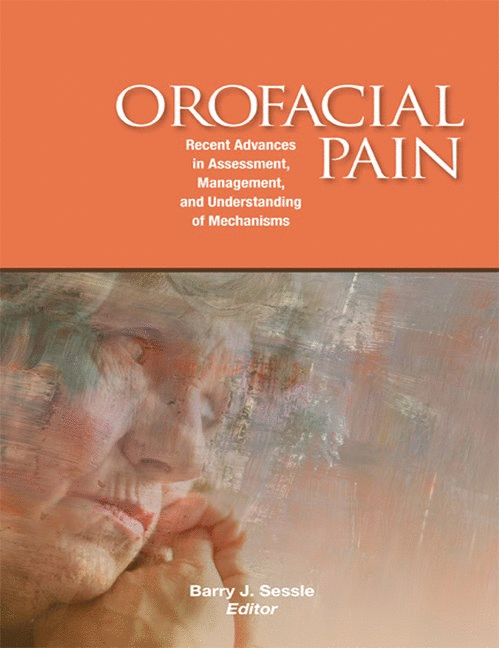
122,50 €When it comes to mechanisms, diagnosis, and management of acute and chronic orofacial pain, no book is more comprehensive than Orofacial Pain. With 54 leading pain specialists documenting the latest research advances and treatments, this book is the new standard resource for understanding, assessing, and managing all aspects of orofacial pain.
Orofacial Pain’s 24 chapters address the epidemiologic, socioeconomic, and psychological aspects of orofacial pain conditions as well as the mechanisms underlying orofacial pain revealed in recent studies in humans and animals.
Most other books on this topic focus on just one or two aspects of orofacial pain—and nearly all with only dental students or clinicians in mind. Orofacial Pain provides the most up-to-date, complete, and integrated coverage of advances in research and new evidence. It is must reading not only for dental clinicians but also for pain scientists and specialists, neurologists, and other clinicians.
About the Author(s)
Dr. Barry J. Sessle MDS, PhD, DSc(hc), FRSC,
Barry J. Sessle, MDS, PhD, DSc(hc), FRSC, CAHS, Professor and Canada Research Chair, Faculties of Dentistry and Medicine, University of Toronto, Toronto, ON, Canada.
Contents
Part I: Advances in Epidemiological, Societal, and Classification Aspects of Orofacial Pain
1: The Societal, Political, Educational, Scientific, and Clinical Context of Orofacial Pain
2: Classification of Orofacial Pain
3: Epidemiology of Orofacial Pain
4: Comorbid Pain and Psychological Conditions in Patients with Orofacial Pain
5: Orofacial Pain, Motor Function, and Sleep
Part II: Advances in Orofacial Pain Assessment
6: Clinical Examination and Adjunctive Laboratory Tests for Physical Diagnosis
7: Self-Report Assessment of Orofacial Pain and Psychosocial Status
8: Neurosensory Testing for Assessment, Diagnosis, and Prediction of Orofacial Pain
9: Neuroimaging and Orofacial Pain
10: Immunological and Neurophysiological Biomarkers of Orofacial Pain
Part III: Advances in Orofacial Pain Management
11: Advances in the Dental and Surgical Management of Orofacial Pain
12: Pharmacological Advances in Orofacial Pain Management
13: Psychosocial and Behavioral Modes of Orofacial Pain Management
14: Advances in Physical Therapy Interventions for Managing Orofacial Pain
15: Advances in the Use of Complementary and Alternative Medicine in the Management of Orofacial Pain
Part IV: What Do Animal Experimental Studies Tell Us About Orofacial Pain Mechanisms?
16: Inflammatory and Cancer-Related Orofacial Pain Mechanisms: Insights from Animal Models
17: Neuropathic Orofacial Pain Mechanisms: Insights from Animal Models
18: Musculoskeletal Orofacial Pain Mechanisms: Insights from Animal Models
19: Genetic Risk Factors for Orofacial Pain: Insights from Animal Models
Part V: What Do Human Experimental Studies Tell Us About Orofacial Pain Mechanisms?
20: Inflammatory and Cancer-Related Orofacial Pain Mechanisms: Insights from Human Experimental Studies
21: Neuropathic Orofacial Pain Mechanisms: Insights from Human Experimental Studies
22: Musculoskeletal Orofacial Pain Mechanisms: Insights from Human Experimental Studies
23: Genetic Risk Factors for Orofacial Pain: Insights from Human Experimental Studies
Part VI: Summary and Future Directions
24: Orofacial Pain: Summary of Recent Advances and Future Directions
 -5%
-5%
 -5%
-5%
 -5%
-5%
 -5%
-5%
 -5%
-5%
 -5%
-5%
 -5%
-5%
 -5%
-5%
 -5%
-5%
 -5%
-5%