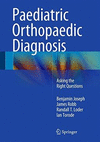
JOSEPH, B.; ROBB, J.; LODER, R.; TORODE, I.
Descuento:
-5%Antes:
Despues:
118,55 €The book presents a problem-based, rational approach to the diagnosis of orthopaedic problems in children. It is divided into four sections based on the age at which specific problems may be encountered; the newborn and infant, the toddler and the pre-school child, the child in the school-going age and the adolescent. The authors outline a systematic approach to arrive at a tentative diagnosis by asking relevant questions related to the presenting symptom and then performing a thorough clinical examination. They then suggest the most appropriate investigations to confirm the diagnosis. Each chapter deals with the common conditions that may lead to the problem; the rarer causes of the problem are listed at the end. This feature would make the book a practical manual and a high quality reference source. An important feature of the book is the number and quality of illustrations and video clips in the electronic version.
Authors
Benjamin Joseph is former Professor of Orthopaedics and Head of Paediatric Orthopaedic Service, Kasturba Medical College, Manipal, India. He is currently Adjunct Professor of Orthopaedics, Christian Medical College, Vellore, India.
Randall Loder is Chief of Orthopaedic Surgery, James Whitcomb Riley Children’s Hospital, and the Garceau Professor of Orthopaedic Surgery, Indiana University School of Medicine, Indianapolis, Indiana, USA.
James Robb is former Consultant Orthopaedic Surgeon, Royal Hospital for Sick Children, Edinburgh, Scotland and Honorary Senior Lecturer, University of St Andrews, Scotland, UK.
Ian Torode is Director of Orthopaedics, Royal Children’s Hospital, Melbourne, Australia.
Table of contents (38 chapter)
1.The Deformed Hip
2.The Deformed Femur
3.The Deformed Knee
4.The Bowed Tibia
5.The Inverted Foot
6.The Everted Foot
7.The Deformed Shoulder Girdle
8.The Deformed Elbow
9.The Deformed Wrist
10.The Deformed Spine in the Newborn
11.Absent Digits in the Hands or Feet
12.Duplication of Fingers
13.Duplication of Toes
14.Deformities of Fingers and Toes in the Newborn
15.Limb Length Inequality at Birth
16.Abnormal Body Proportions and Dwarfism at Birth
17.Decreased Movement of the Upper or Lower Limb in the Neonate
18.Deformity of the Neck and Limitation of Movement of the Neck in the Neonate and Infant
19.The Child with Multiple Deformities
20.Acquired Deformities of the Knee
21.In-Toeing and Out-Toeing Gait
22.Toe Walking
23.The Flatfoot
24.The Child with a Painless Limp
25.The Delayed Walker
26.Deformities and Limitation of Movements of the Shoulder Girdle
27.Deformities and Limitation of Movement of the Elbow
28.Deformities and Limitation of Motion of the Forearm
29.Deformities and Limitation of Movement of the Wrist
30.Brittle Bones and Frequent Fractures
31.The Child with a Painful Limp
32.The Painful Hip
33.Short Stature and Altered Body Proportions
34.Localized Gigantism of the Limbs
35.Acquired Limb Length Inequality
36.The Painful Hip in Adolescence
37.The Painful Knee in Adolescence
38.The Painful Foot in Adolescence
 -5%
-5%
 -5%
-5%
 -5%
-5%
 -5%
-5%
 -5%
-5%
 -5%
-5%
 -5%
-5%
 -5%
-5%
 -5%
-5%
 -5%
-5%