Descuento:
-5%Antes:
Despues:
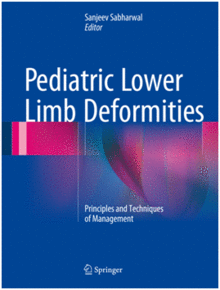
158,07 €Comprehensive and generously illustrated, this text highlights both general principles and specific strategies for managing the spectrum of pediatric lower limb deformities. It is divided thematically into five sections, though any chapter can stand on its own to guide the clinician in specific situations. Part I covers general principles and techniques, including etiology, clinical evaluation, imaging as well as different surgical methods. Part II, covering related concepts and management options, discusses soft tissue contractures, amputations and working in austere and resource-challenged settings. Underlying conditions comprise part III – specific metabolic, neuromuscular and tumor-related conditions, along with arthrogryposis, Osteogenesis Imperfecta and various skeletal dysplasias. Part IV presents congenital and developmental disorders, such as congenital femoral deficiency, hemimelias, tibial pseudoarthrosis and Blount disease, while part V rounds out the book with chapters on sequelae related to different etiologies and their treatment. Covering all aspects of the management of pediatric lower limb deformities and written by renowned experts in the field, this textbook will be an invaluable resource for orthopedic surgeons and trainees worldwide.
Author
Sanjeev Sabharwal, MD, MPH. Professor, Department of Orthopedics. Chief, Division of Pediatric Orthopedics. Rutgers-New Jersey. Medical School. Newark, NJ, USA.
Table of contents (32 chapters)
1.Etiology of Lower Limb Deformity
2.Clinical Evaluation Including Imaging
3.Decision Making in Lower Extremity Deformity Correction
4.Growth Modulation for Angular and Length Correction
5.Physeal Bar Excision
6.Acute Deformity Correction Using an Osteotomy
7.Gradual Deformity Correction
8.Hybrid Techniques for Limb Length and Deformity Correction
9.Motorized Intramedullary Lengthening, an Emerging Technology for Limb Length and Deformity Correction
10.Biomechanically Based Clinical Decision Making in Pediatric Foot and Ankle Surgery
11.Pediatric Joint Contractures
12.Physical Therapy During Limb Lengthening and Deformity Correction: Principles and Techniques
13.Amputation and Prosthetic Management: Amputation as a Reconstructive Option
14.Working in Resource-Challenged Environments
15.Metabolic Disorders
16.Osteogenesis Imperfecta
17.Lower Limb Deformity in Neuromuscular Disorders: Pathophysiology, Assessment, Goals, and Principles of Management
18.Arthrogryposis
19.Limb Lengthening and Deformity Correction in Patients with Skeletal Dysplasias
20.Lower Extremity Benign Bone Lesions and Related Conditions
21.Management of Juxtaphyseal Malignant Bone Tumors Around the Knee Joint: New Concepts in Limb-Sparing Surgery
22.Congenital Femoral Deficiency Reconstruction and Lengthening Surgery
23.Fibular Hemimelia: Principles and Techniques of Management
24.Tibial Hemimelia
25.Congenital Pseudarthrosis of the Tibia
26.Congenital Posteromedial Bowing of the Tibia
27.Controversies in Blount’s Disease
28.Methods to Enhance Bone Formation in Distraction Osteogenesis
29.Residual Deformities of the Hip
30.Posttraumatic Lower Limb Deformities in Children
31.Postinfectious Deformities of the Lower Limb
32.Iatrogenic Deformities
 -5%
-5%
 -5%
-5%
 -5%
-5%
 -5%
-5%
 -5%
-5%
 -5%
-5%
 -5%
-5%
 -5%
-5%
 -5%
-5%
 -5%
-5%