Descuento:
-5%Antes:
Despues:
167,96 ۥ Part I. Fundamentals of Fluid Management
1. A History of Fluid Management
2. The Revised Starling Principle and its Relevance to Perioperative Fluid Management
3. The Functions of Endothelial Glycocalyx and Their Effects on Patient Outcomes During the Perioperative Period. A Review of Current Methods to Evaluate Structure-Function Relations in the Glycocalyx in Both Basic Research and Clinical Settings
4. Techniques for Goal-Directed Fluid Management
5. The Perioperative Use of Echocardiography for Fluid Management
6. Microcirculatory Blood Flow as a New Tool for Perioperative Fluid Management
7. Mean Systemic Filling Pressure Is an Old Concept but a New Tool for Fluid Management
8. Restricted or Liberal Fluid Therapy
9. The Perioperative Use of Albumin
10. The Dilemma for Using Hydroxyethyl Starch Solutions for Perioperative Fluid Management
11. Balanced Versus Unbalanced Salt Solutions in the Perioperative Period
12. Positive Fluid Balance and Patients’ Outcomes
13. Fluid Management and Its Role in Enhanced Recovery
• Part II: Case Scenarios Management During Colorectal, Orthopedic and Spine Cases
14. Case Scenario for Perioperative Fluid Management in Major Orthopedic Surgery
15. Case Scenario for Perioperative Fluid Management for Major Colorectal Surgery
16. Case Scenario for Fluid Therapy in Septic Shock
17. Case Scenario for Fluid Management in Liver Resection
18. Case Scenario for Fluid Management During Major Spine Surgery
19. Case Scenario for Fluid Management After Subarachnoid Hemorrhage in the Neuro-Intensive Care Unit.
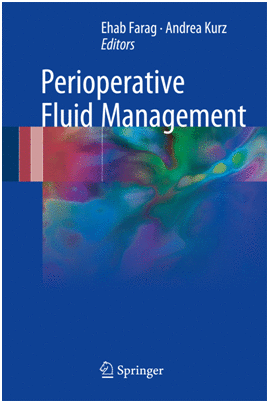
This book presents the most recent evidence-based facts on perioperative fluid management and discusses fluid management from basic sciences to clinical applications and the patients’ outcomes.
Recent advances in understanding the Revised Starling principle with new concepts in tissue perfusion and the most recent techniques of perioperative goal directed fluid management are described. The endothelial glycocalyx functions and the influence of fluid management on its integrity are covered in detail; moreover, the techniques for its protection are also discussed. The dilemma of perioperative use of hydroxyethyl starch solutions and the resurgence of interest in using human albumin as an alternative colloid is explored. The problems of using unbuffered solutions during the perioperative period and comparison between restrictive versus liberal fluid management are discussed in full.
Perioperative Fluid Management will be of interest to anesthesiologists and also intensivists.
Features
• Authored by influential physicians in perioperative fluid management
• Describes recent major updates in the field, such as the revised Starling principle, goal directed fluid management and perioperative use of albumin
• Discusses the relation between positive fluid balance and patient mortality
Author
Dr. Ehab Farag MD FRCA is Professor of Anesthesiology in Cleveland Clinic Lerner College of Medicine and Director of Clinical Research in Department of General Anesthesia, Anesthesia Institute, at the Cleveland Clinic. Dr. Farag has trained in UK where he received the Fellowship of the Royal College of Anesthetists. Dr. Farag completed his training in anesthesia in Cleveland Clinic and received his fellowship training in Neuroanesthesia in Toronto Western hospital – Toronto University and Cleveland Clinic. Dr. Farag has published 50 peer review publications. Moreover, he edited and authored six books in Neuroanesthesia, Neurosciences, Regional Anesthesia and Fluid Management. Dr. Farag’s research is primarily focused in Neuroanesthesia, Regional Anesthesia and Fluid Management.
 -5%
-5%
 -5%
-5%
 -5%
-5%
 -5%
-5%
 -5%
-5%
 -5%
-5%
 -5%
-5%
 -5%
-5%
 -5%
-5%
 -5%
-5%