Descuento:
-5%Antes:
Despues:
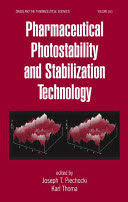
171,00 €History of Pharmaceutical Photostability Development. The ICH Photostability Guideline: A Discussion of Experimental Conditions. Terminology. Basic Principles of Drug Photostability Testing. Spectra. Sources. Glasses, Filters, and Containers. Chemical Actinometry. Radiometry/Photometry. Sample Presentation for Photostability Studies: Problems and Solutions. Determining the Kinetics and Mechanism of a Photochemical Reaction. Unexpected Photochemistry in Pharmaceutical Products: A Review on the Role of Diluents, Excipients, and Product Components in Promoting Pharmaceutical Photochemistry. Chambers and Mapping. Current Methods for the Analytical Investigation of the Photodegradation of Active Pharmaceutical Ingredients and Products. Photostabilization by Packaging. Photostabilization of Solid and Semisolid Dosage Forms. Photostability Studies of Solutions and Methods of Preventing Photodegradation. Photostability of Cosmetic Screens. Photodegradation and Photoprotection in Clinical Practice.
Based on a training course developed by Dr. Joseph T. Piechocki and other experts in this field whose contributions appear in this book for two International Meetings on the Photostability of Drugs and Drug Products, this text clarifies the guidelines set by the International Conference on Harmonization (ICH) and provides a comprehensive background in the scientific principles involved in photostability testing. Presenting the advantages and disadvantages of various procedures so the reader can select and utilize the most appropriate technique best-suited to their needs, this source includes references to current literature in the field and offers an opinion on future opportunities and challenges.
Features
Including contributions from international experts, this guide
• assists in the selection of the most appropriate photon source and actinometer for specific applications
• devotes an entire chapter on the study of chemical actinometry—a stable, self-standardizing method of radiation dosage assessment
• focuses attention on molecular mechanisms and kinetics and their importance in the development of protective measures
• offers reviews of the available testing chambers for pharmaceutical photochemical studies
• details protective methods for all dosage forms useful in preventing photodegradation
• includes information on the use, action, and methods of determination of the effectiveness and stabilization of sunscreens Audience
 -5%
-5%
 -5%
-5%
 -5%
-5%
 -5%
-5%
 -5%
-5%
 -5%
-5%
 -5%
-5%
 -5%
-5%
 -5%
-5%
 -5%
-5%