Descuento:
-5%Antes:
Despues:
158,07 €1. Classical Orthodontic Anchorage: A Century of Progress
2. Paradigm Shift by Straight Wire Appliance and Its Impact on Anchorage Control
3. Craniofacial Growth and Its Interaction with the Maxillary Anchor Molars
4. Concept of Physiologic Anchorage Loss
5. Mechanical Properties of Various Archwires and Their Clinical Application in the PASS System
6. Biomechanics of Physiologic Anchorage Control
7. Drift of Dentition and Low-Friction Appliance
8. Physiologic Anchorage Control System
9. The Basic Treatment Procedures of PASS Technique
10. Class I Cases with Four First Premolars Extraction
11. Treatment of Class II Malocclusion with PASS Technique
12. Treatment of Class III Malocclusion with PASS Technique
13. Vertical Control in PASS
14. Atypical Extraction Cases
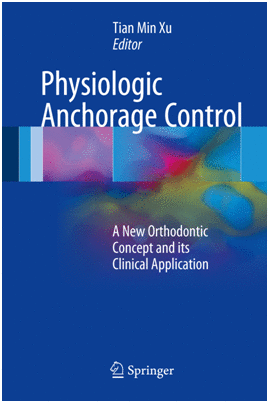
This book provides a comprehensive introduction to physiologic anchorage control, explains the implications for clinical practice, and presents an anchorage technique applicable for the treatment of different malocclusions. The concept of physiologic anchorage control is derived from observations of upper molar movement during growth in adolescence, including in the absence of orthodontic treatment, which indicate that molar forward displacement comprises two components: the first due to biologic force or physiologic anchorage loss and the second due to orthodontic force or mechanical anchorage loss. All previous anchorage methods have been based on the assumption that molar anchorage loss is to be attributed solely to the mechanical force used to retract anterior teeth, and the new concept represents a paradigm shift of clinical significance. This book explores the pattern of upper molar growth in depth, highlights the physiologic significance of the curve of Spee, and analyzes the biomechanics of physiologic anchorage control. An anchorage control system that fully takes into account the latest conceptual insights is described and its clinical use and utility, examined.
Features
• Discusses in depth the novel concept of physiologic anchorage control, based on observations of upper molar movement during growth in adolescence
• Explains the implications for anchorage designs
• Presents a physiologic anchorage control system and discusses its clinical application
Author
Tian-Min Xu has been a Professor in the Department of Orthodontics at the School of Stomatology, Peking University, Beijing, China since 2003. Dr. Xu obtained his DDS from Nanjing Medical College, Faculty of Dentistry in 1986 before obtaining an MS and PhD from Peking University, School of Stomatology and completing a postdoc at the University of California, San Francisco, CA, USA. He is a Standing Committee Member and past President of the Chinese Orthodontic Society and a Trustee of Council for the Chinese Stomatological Association. He has also served as a member of the WFO Council and an Executive Committee Member of the Asian-Pacific Orthodontic Society. Dr. Xu is an editorial board member for several journals, including Orthodontics and Craniofacial Research, European Journal of Orthodontics and is a member of the review board for the American Journal of Orthodontics and Dentofacial Orthopedics. He is the author of more than 40 papers in international peer-reviewed journals as well as more than 100 papers in Chinese journals. He has co-edited three books, including Chinese Contemporary Orthodontics , 4th ed. (Peking University Medical Press, 2014).
 -5%
-5%
 -5%
-5%
 -5%
-5%
 -5%
-5%
 -5%
-5%
 -5%
-5%
 -5%
-5%
 -5%
-5%
 -5%
-5%
 -5%
-5%