Descuento:
-5%Antes:
Despues:
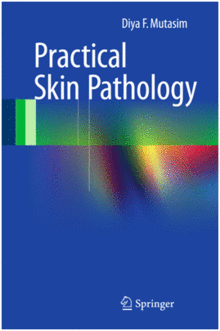
108,67 €- Only book of its kind to address both the clinical education of each disease as well as the pathology findings
- Authored by a leader in clinical dermatology, dermatopathology, and skin immunology
- Written for dermatologists, dermatology residents, and dermatopathologists
- Addresses questions commonly faced by a physician looking to perform best practices
- Includes dozens of color illustrations, images, and tables
This engaging new text teaches students, residents, and practitioners of all ages how to use insights from both pathologists and dermatologists to improve their comprehension of skin disorders. It is meant to bridge the gap between dermatology and dermapathology and explores the questions that practitioners have that fall between the two subjects. What is a dermatologist to do with a pathology report that has a histological rather than a clinical diagnosis? What is to be done with old names of disorders that some clinicians still use? Why do some disorders have many names, and which is better and why? These and dozens of other questions are answered in Practical Skin Pathology, the only book of its kind to address both the clinical education of each disease as well as the pathology findings. Authored by a leader in clinical dermatology, dermatopathology, and skin immunology, Practical Skin Pathology is written for dermatologists, dermatology residents, and dermatopathologists. Addressing such questions as whether to accept a differential diagnosis from a dermatopathologist rather than a specific diagnosis and when, to how to help a pathologists give a dermatologist the best possible interpretation of a biopsy, this quick reference includes color illustrations, images, and tables to better assist the physician in answering these common questions and concerns.
Author
Diya F. Mutasim, MD, has taught residents both dermatology and pathology for 25 years, has been residency program director for more than 20 years and dermatopathology fellowship program director for more than 10 years, and is a professor in the Department of Dermatology at the University of Cincinnati College of Medicine.
Table of contents (41 chapters)
1.What is Atypical Junctional Melanocytic Hyperplasia?
2.What Is Dysplastic Nevus?
3.What Is Hypersensitivity Reaction?
4.What Is Spongiotic Dermatitis?
5.What Is Psoriasiform Dermatitis?
6.What Is Lichenoid Dermatitis?
7.What Is Granulomatous Dermatitis?
8.What Is Dermatitis with Epidermotropism?
9.What Is Drug Eruption?
10.What Is Pseudolymphoma?
11.Reddish Facial Papules
12.Face infiltrated Plaques/Nodules
13.Patchy Alopecia
14.Diffuse Smooth Alopecia
15.Follicular Pustules of the Scalp
16.Scaly Scalp
17.Oral Erosions
18.Vulvar Lesions
19.Penile Lesions
20.Diffuse Leg Induration
21.Subcutaneous Leg Nodules
22.Leg Ulcers
23.Follicular Papules and Pustules—Trunk
24.Palmoplantar Red Hyperkeratosis
25.Skin Folds Diffuse Rash
26.Exfoliative Erythroderma
27.Generalized Pruritus
28.Photo-Eruptions
29.Hypopigmented Patches
30.Pigmented Patches
31.Red Smooth Patches
32.Red Scaly Patches
33.Red Sloughing Patches
34.Red Scaly Papules
35.Red Non-Facial Papules
36.Papulonodular Lesions with Scale and/or Crust
37.Edematous Smooth Plaques
38.Sclerotic Plaques
39.Diffuse Sclerosis
40.Purpuric Lesions
41.Blisters
 -5%
-5%
 -5%
-5%
 -5%
-5%
 -5%
-5%
 -5%
-5%
 -5%
-5%
 -5%
-5%
 -5%
-5%
 -5%
-5%
 -5%
-5%