Descuento:
-5%Antes:
Despues:
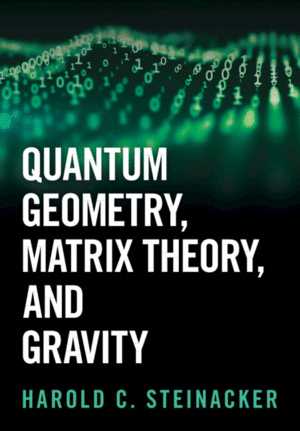
88,35 €Building on mathematical structures familiar from quantum mechanics, this book provides an introduction to quantization in a broad context before developing a framework for quantum geometry in Matrix Theory and string theory. Taking a physics-oriented approach to quantum geometry, this framework helps explain the physics of Yang–Mills-type matrix models, leading to a quantum theory of space-time and matter. This novel framework is then applied to Matrix Theory, which is defined through distinguished maximally supersymmetric matrix models related to string theory. A mechanism for gravity is discussed in depth, which emerges as a quantum effect on quantum space-time within Matrix Theory. Using explicit examples and exercises, readers will develop a physical intuition for the mathematical concepts and mechanisms. It will benefit advanced students and researchers in theoretical and mathematical physics, and is a useful resource for physicists and mathematicians interested in the geometrical aspects of quantization in a broader context.
• The first comprehensive work on quantum spaces and matrix models, this book provides a systematic and self-contained introduction that makes these subjects accessible to non-experts without having to go through the research literature
• Includes intuitive, physics-oriented discussions, explaining the motivation and relation with other approaches so that the basic ideas and physical motivation can be readily understood
• Includes a systematic discussion of the mathematical concept of quantization, which is useful to readers interested in the context of quantum mechanics more broadly
• Introduces an original approach to quantum gravity via matrix models, including novel techniques of string modes, through a systematic and detailed discussion, providing a useful resource for related research
 -5%
-5%
 -5%
-5%
 -5%
-5%
 -5%
-5%
 -5%
-5%
 -5%
-5%
 -5%
-5%
 -5%
-5%
 -5%
-5%
 -5%
-5%