Descuento:
-5%Antes:
Despues:
108,67 €1. Liver Anatomy and Function
2. Imaging Characteristics of Normal Liver and Liver Tumors
3. Assessment of Liver Function: Focus on the ALBI Score
4. Radiation Sensitivity of the Liver: Models and Clinical Data
5. Radiation Oncology: Fundamentals and Controversies
6. Surgical Considerations
7. Principles of Intra-Arterial Therapies
8. Principles of Thermal Ablation
9. External Beam Radiation Therapy for Liver Tumors: Simulation, Treatment Planning, and Advanced Delivery Techniques
10. Particle Radiation Therapy for Liver Tumors: Simulation and Treatment Planning
11. Yttrium-90 Selective Internal Radiation Therapy
12. Interstitial Brachytherapy for Liver Tumors: Practical Issues
13. Hepatocellular Carcinoma: Epidemiology, Basic Principles of Treatment, and Clinical Data
14. Radiation Therapy for Hepatocellular Carcinoma: Clinical Data
15. Intrahepatic and Hilar Cholangiocarcinomas: Epidemiology, Basic Principles of Treatment, and Clinical Data
16. Radiation Therapy for Intrahepatic and Hilar Cholangiocarcinoma: Clinical Data
17. Liver Metastases: Basic Principles of Treatment and Clinical Data
18. Radiation Therapy for Liver Metastases: Clinical Data
19. Multidisciplinary Model for Liver Tumors
20. Radiation Therapy for Liver Tumors: Future Directions
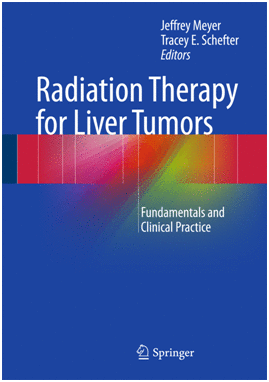
The management of liver tumors is a nexus of interactions among multiple medical specialties, including radiation oncology. A multitude of liver-directed therapies are available for patients, ranging from surgery and liver transplantation to intra-arterial therapies, thermal ablation procedures, systemic therapies, and radiation treatments. With the introduction of hypofractionated irradiation, particle therapy, and radioembolization, there is growing interest in the use of radiation as a treatment for liver malignancies.
This book examines basic principles of the management of liver tumors. The evolving roles of x-ray and particle therapies as well as radioembolization in the treatment of liver tumors is the main focus. A theme of multidisciplinary management is also emphasized, as surgical, interventional and systemic therapies are reviewed.
A unique resource that discusses the role of radiation treatment in the context of other liver-directed therapies, Radiation Therapy for Liver Tumors is of broad interest to radiation oncologists, surgeons, hepatologists, medical oncologists, and radiologists.
Features
• Describes the results of various radiation modalities, such as external beam particle and x-ray therapy, radioembolization, and interstitial brachytherapy, used to treat liver tumors
• Details radiation therapy for hepatocellular cancer, intrahepatic and hilar cholangiocarcinoma, and liver metastases
• Presents the advantages and disadvantages of radiation therapy for liver tumors with respect to other liver-directed therapies
• Explores the role of radiation therapy in the context of the growing field of interventional oncology procedures
Authors
• Jeffrey Meyer, MD, MS, Department of Radiation Oncology, University of Texas Southwestern Medical Center, Dallas, TX, USA,
• Tracey E. Schefter, MD, Department of Radiation Oncology, University of Colorado Comprehensive Cancer Center, Aurora, CO, USA
 -5%
-5%
 -5%
-5%
 -5%
-5%
 -5%
-5%
 -5%
-5%
 -5%
-5%
 -5%
-5%
 -5%
-5%
 -5%
-5%
 -5%
-5%