Descuento:
-5%Antes:
Despues:
71,09 ۥ Chapter 1: Introduction
1.1 Using This Book
1.2 Warm-Up Examples
1.3 Statistics and the Law
• Chapter 2: Basics
2.1 Forensic Markers
2.2 Probabilities of Genotypes
2.3 Likelihoods and LRs
2.4 Mutation
2.5 Theta Correction
2.6 Silent Allele
2.7 Dropout
2.8 Exclusion Probabilities
2.9 Beyond Standard Markers and Data
2.10 Simulation
2.11 Several, Possibly Complex Pedigrees
2.12 Case Studies
2.13 Exercises
• Chapter 3: Searching for Relationships
3.1 Introduction
3.2 Disaster Victim Identification
3.3 Blind Search
3.4 Familial Searching
3.5 Exercises
• Chapter 4: Dependent Markers
4.1 Linkage
4.2 Linkage Disequilibrium
4.3 Haplotype Frequency Estimation
4.4 Programs for Linked Markers
4.5 Exercises
• Chapter 5: Relationship Inference with R
5.1 Using R
5.2 Exercises
• Chapter 6: Models for Pedigree Inference
6.1 Population-Level Models
6.2 Pedigree-Level Models
6.3 Observational-Level Models
6.4 Computations
6.5 Exercises
• Chapter 7: Parameter Estimation and Uncertainty
7.1 Allele Frequencies
7.2 The Theta-Correction Parameter
7.3 The Lambda Model for Haplotype Frequencies
7.4 Mutations and Mutation Models
7.5 Other Parameters
7.6 Handling “Uncertainty” in LRs
7.7 Exercise
• Chapter 8: Making Decisions
8.1 Some Basic Decision Theory
8.2 LR as a Random Variable
8.3 Exercises
• Glossary for non-biologists
• Bibliography
• Index
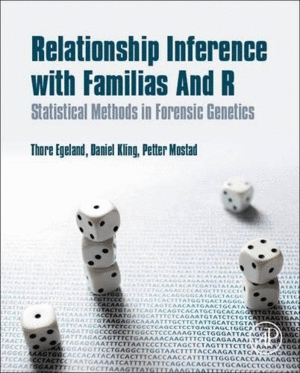
• This volume focuses on the core material and omits most general background material on probability, statistics and forensic genetics
• Each chapter includes exercises with available solutions
• The web page familias.name contains supporting material
Authors
• Thore Egeland, Norwegian University of Life Sciences, Norway.
• Daniel Kling, Norwegian Institute of Public Health, Norway.
• Petter Mostad, Chalmers University of Techonology, Göteborg, Sweden
 -5%
-5%
 -5%
-5%
 -5%
-5%
 -5%
-5%
 -5%
-5%
 -5%
-5%
 -5%
-5%
 -5%
-5%
 -5%
-5%
 -5%
-5%