Descuento:
-5%Antes:
Despues:
93,07 €PART I. LIGAND BINDING TO SINGLE BINDING SITE TARGETS
Chapter 1: THEORY OF LIGAND BINDING TO MONOMERIC PROTEINS
1.1 Importance of ligand binding phenomena in biology
1.2 Preliminary requirements for ligand-binding study
1.3 Chemical equilibrium and the law of Mass Action
1.4 The hyperbolic and sigmoidal representations of the ligand binding isotherms
1.5 The important concept of X1/2
1.6 Other representations of the ligand binding isotherms
1.7 Effect of temperature; thermodynamic relationships
1.8 Replacement reactions; competitive ligands
1.9 Heterotropic linkage: non competitive binding of two ligands
1.10 Allostery and allosteric phenomena in monomeric proteins
1.11 The special case of Cys ligands (and similar reactions)
1.12 Other special cases
Chapter 2: LIGAND BINDING KINETICS FOR SINGLE SITE PROTEINS
2.1 Basic concepts of chemical kinetics: irreversible reactions.
2.2 Reversible reactions: equilibrium and kinetics
2.3 More complex kinetic mechanisms
2.4 Reactions wit molecularity higher than 2
2.5 Classical methods for the study of ligand binding kinetics
2.6 Photochemical kinetic methods
2.7 The kinetics of replacement reactions
Appendix to Chapter 2: Principles of data analysis.
Chapter 3: PRACTICAL CONSIDERATIONS AND COMMONLY ENCOUNTERED PROBLEMS.
3.1 Design of the experiment: the free ligand concentration
3.2 The signal and the concentration of the target
3.3 Test of the reversibility of the reaction
3.4 Frequent abuses of the concept of X1/2
3.5 Two common problems: protein precipitation and baseline shifts
3.6 Low-affinity ligands
3.7 High-affinity ligands
3.8 Determination of the reaction stoichiometry
3.9 Gaseous and otherwise heterogeneous ligands
3.10 Mixtures of isoforms
3.11 Poor or absent signal
PART II: LIGAND BINDING TO MULTIPLE BINDING SITES PROTEINS
Chapter 4: (OLIGOMERIC) PROTEINS WITH MULTIPLE BINDING SITES
4.1 Multiple binding sites: determination of the binding stoichiometry
4.2 The binding polynomial of a homooligomeric protein made up of identical subunits
4.3 Intramolecular heterogeneity
4.4 Oligomeric proteins with interacting sites; homotropic linkage
4.5 Cooperativity: biochemistry and physiology
4.6 Allostery and symmetry: the allosteric model of cooperativity
4.7 Two alternative concepts of cooperativity
4.8 Ligand replacement in oligomeric proteins
4.9 Heterotropic linkage in multimeric proteins
4.10 Heterotropic linkage and the allosteric model
Appendix 4.1: Satistical distribution of the ligand among the binding sites; statistical factors.
Appendix 4.2: Symmetry of the vs. log([X]) plot: the concept of Xm.
Chapter 5: LIGAND-LINKED ASSOCIATION AND DISSOCIATION
5.1 Quaternary constraint and quaternary enhancement
5.2 The reversibly dissociating homodimer devoid of ligand-linked association equilibria
5.3 Ligand-linked association-dissociation in the non-cooperative homodimer
5.4 Ligand-linked association-dissociation in the non-binding homodimer
5.5 Monomers that self-associate to homodimers upon ligation
5.6 Ligand-linked association-dissociation in cooperative proteins
5.7 One ligand per dimer: ligand binding sites at intersubunit interfaces
5.8 Ligand-linked association-dissociation in the framework of the allosteric model
5.9 Practical considerations
Chapter 6: KINETICS OF LIGAND BINDING TO PROTEINS WITH MULTIPLE BINDING SITES.
6.1 Stepwise ligand binding to homooligomeric proteins
6.2 Ligand binding to heterooligomeric proteins
6.3 Study of the time course of ligand dissociation
6.4 Practical problems in the study of ligand binding kinetics with oligomeric proteins
6.5 Advanced experimental techniques for the study of ligation intermediates
6.6 Integration of equilibrium and kinetic data for cooperative systems
6.7 Ligand binding kinetics in the framework of the allosteric model
Appendix 6.1: Kinetic statistical factors
Chapter 7: HEMOGLOBIN AND ITS LIGANDS
7.1 The heme and its ligands
7.2 Reversible ligand binding and cooperativity
7.3 The structure of hemoglobin
7.4 Ligation-dependent structural changes
7.5 Quaternary constraint
7.6 Structural aspect of cooperativity; allostery
7.7 Structure and energy degeneracy
7.8 Kinetics of ligand binding
7.9 Ligation intermediates: measurement and structure
7.10 Ligand-linked dissociation into dimers
7.11 Non human hemoglobins; human hemoglobin mutants
Chapter 8: Single-substrate enzymes and their inhibitors
8.1 Enzymes, substrates and inhibitors: a special case of ligand binding.
8.2 Importance of initial velocity studies; zero order kinetics
8.3 Linearizations of the Michaelis-Menten hyperbola
8.4 Enzymatic catalysis of reversible reactions
8.5 The study of enzyme inhibitors under the pseudo-equilibrium approximation
8.6 Inhibitors that bind to the same site as the substrate (pure competitive inhibitors)
8.7 Different types of heterotropic (non-competitive) inhibitors
8.8 Heterotropic regulation of enzyme activity
Chapter 9: Two-substrate enzymes and their inhibitors
9.1 Two basic catalytic mechanism for two-substrate enzymes
9.2 Steady-state parameters of two-substrate enzymes that do not form a ternary complex
9.3 Competitive inhibitors of two-substrate enzymes that do not form a ternary complex
9.4 Steady-state parameters of two-substrate enzymes forming a ternary complex
9.5 Competitive inhibitors of two-substrate enzymes forming a ternary complex
Chapter 10: Beyond the steady-state: rapid kinetic methods for studying enzyme reactions
10.1 Structural and catalytic properties of copper-containing amine oxidases
10.2 Experimentally accessible information on copper-amine oxidases
10.3 From the kinetic constants to the steady-state parameters
10.4 The method of King and Altman to derive steady state parameters
Chapter 11: Slowly-binding and irreversible enzyme inhibitors.
11.1 Definitions and classifications
11.2 Test of reversibility of binding
11.3 Slowly-equilibrating competitive inhibitors
11.4 Rapidly binding irreversible inhibitors
11.5 Slowly binding irreversible inhibitors
11.6 Mechanism-based inhibitors
Presents the physical background of ligand binding and instructs on how experiments should be designed and analyzed
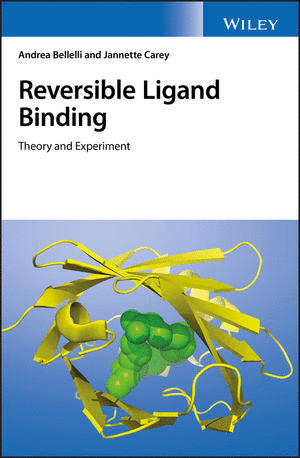
Reversible Ligand Binding: Theory and Experiment discusses the physical background of protein-ligand interactions—providing a comprehensive view of the various biochemical considerations that govern reversible, as well as irreversible, ligand binding. Special consideration is devoted to enzymology, a field usually treated separately from ligand binding, but actually governed by identical thermodynamic relationships. Attention is given to the design of the experiment, which aids in showing clear evidence of biochemical features that may otherwise escape notice. Classical experiments are reviewed in order to further highlight the importance of the design of the experiment. Overall, the book supplies students with the understanding that is necessary for interpreting ligand binding experiments, formulating plausible reaction schemes, and analyzing the data according to the chosen model(s).
Topics covered include: theory of ligand binding to monomeric proteins; practical considerations and commonly encountered problems; oligomeric proteins with multiple binding sites; ligand binding kinetics; hemoglobin and its ligands; single-substrate enzymes and their inhibitors; two-substrate enzymes and their inhibitors; and rapid kinetic methods for studying enzyme reactions.
• Bridges theory of ligand binding and allostery with experiments
• Applies historical and physical insight to provide a clear understanding of ligand binding
• Written by a renowned author with long-standing research and teaching expertise in the area of ligand binding and allostery
• Based on FEBS Advanced Course lectures on the topic
Reversible Ligand Binding: Theory and Experiment is an ideal text reference for students and scientists involved in biophysical chemistry, physical biochemistry, biophysics, molecular biology, protein engineering, drug design, pharmacology, physiology, biotechnology, and bioengineering.
Authors
• Andrea Bellelli, PhD is a Professor of Biochemistry at the University of Rome Sapienza. He chaired the Department of Biochemical Sciences "A. Rossi Fanelli" and currently chairs the Medicine and Surgery "B" school at the same University. His research focuses on structural and functional properties of oxygen carrying proteins.
• Jannette Carey, PhD is a Professor of Chemistry at Princeton University and a visiting scientist of the Academy of Sciences of the Czech Republic at Nové Hrady, where she initiated and organizes a biennial FEBS practical and lecture course, Ligand binding theory and practice.
 -5%
-5%
 -5%
-5%
 -5%
-5%
 -5%
-5%
 -5%
-5%
 -5%
-5%
 -5%
-5%
 -5%
-5%
 -5%
-5%
 -5%
-5%