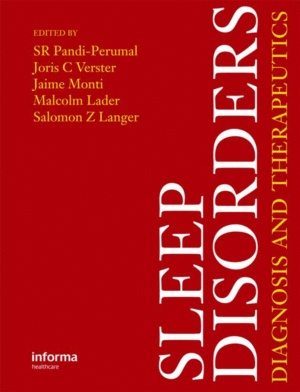
PANDI-PERUMAL, S.R.; VERSTER, J.; MONTI, J.; LANGER, S.
Descuento:
-5%Antes:
Despues:
253,65 €1. Classification of Sleep Disorders
2. Sleep Loss and Sleepiness
3. Approach to the patient with sleep complaint
4. Manifestations of hypersomnia
5. Neuropsychology of Sleep
6. Receptor mechanisms in sleep and wakefulness
7. Transient Insomnia: A Behavioral Sleep Medicine Perspective
8. Chronic insomnia
9. Robound with Hypnotic medication
10. Benzodiazepines: An overview
11. Benzodiazepines: Effects on memory functioning
12. Behavioral therapy, sleep hygiene and psychotherapy
13. Sleep factors
14. The Cytoch P450 enzyme systems: Its relevance to the Pharmacology of sleep
15. Pharmacokinetics: Basic Concepts for dosage regimen considerations
16. Chronopharmacology: Principles and applications in sleep medicine
17. Sleep and Geriatric Psychopharmacology
18. Antihistamines and sleep
19. First generation hypnotics and sedatives
20. GABA-BZD receptors as target for new hypnotics
21. Benzodiazepines: Effects on sleep
22. Indiplon
23. Serotonergic drugs as sleep medications
24. Prostaglandins and sleep/wake regulation
25. Function of endocannabinoids and related compounds in sleep
26. Sleep Medications: When to Prescribe and Rationale for Use
27. Stimulants: Mechanisms and Therapeutic Prospects
28. Zolpidem: its use in the treatment of sleep disorders
29. Eszopiclone: Efficacy and Safety
30. Zaleplon
31. Z-Drugs: Comparative tolerability
32. Rationale for the development of the Z–drugs
33. Metalonin and other indolamines: their involvement in sleep regulation
34. Ramelteon: a Melatonin receptor agonist
35. The rationale for the development of melatonin receptor ligands
36. Schizophrenia, Sleep and Antipsychotic Drugs
37. Interrelationships Between Sleep, Depression and Antidepressant Drugs
38. Effect of antiepileptic medications on sleep architecutre
39. Hormones and sleep
40. Timezone travel, jet lag and sleep disturbances
41. Alcohol, Sleep, Sleep Disorders, and Consequent Daytime Impairment
42. Sleep medication and traffic safety
43. Effect of hypnotic drugs on body balance and standing steadiness
44. Neuropharmacology of Opioids
45. Sleep and Breathing Disorders in Adults
46. Continuous Positive Airway Pressure Therapy
47. Pharmacological Treatment of Obstructive Sleep Apnea
48. Surgical Options in Snoring and Obstructive Sleep Apnea
49. Restless Legs Syndrome: Treatment Options
50. Restless Legs Syndrome: effects on cognitive functioning, memory and psychomotor performance
51. Pharmacological treatment of narcolepsy
52. Modafinil and neuropharmacology of Narcolepsy
53. Narcolepsy: effects on cognitive functioning, memory and psychomotor performance
54. Dreams: Physiology, Pharmacology and Psychology
55. Sleep and Dreaming: Medication effects and side-effects
56. The Subjective Measurement of Excessive Daytime Sleepiness
57. The Multiple Sleep Latency Test and Maintenance of Wakefulness Test: Use and Procedures
58. The OSLER test
59. The Pittsburgh Sleep Quality Index
60. Scoring Rules and General Guidelines for the Pittsburgh Insomnia Rating Scale (PIRS)
61. The Athens Insomnia Scale
62. The Leeds Sleep Evaluation Questionnaire (LSEQ) for psychopharmacology research
63. Sleep Hygiene Practice Scale (SHPS)
64. Cyclic Alternating pattern (CAP)
65. Body Mass Index
One of the first such volumes in this field, Sleep Disorders: Diagnosis and Therapeutics explores sleep pharmacology and therapeutics. Leading researchers in the area of experimental and clinical and psychopharmacology critically assess the progress in their specialist fields. The book is suitable as an introduction for clinicians and researchers who are new to sleep pharmacology and outlines the wider range of therapeutic options currently available to them. For seasoned clinicians, the book will assist in selecting the most appropriate methodologies and treatment options designed to circumvent the problems in combating sleep disorders.
Authors
• S.R. Pandi-Perumal is a Sleep Disorders Specialist at the State University of New York / Downstate Medical Center (SUNY DMC) which is a major provider of medical education, healthcare, and research in the downstate New York region. He is well-recognized sleep researcher both nationally and internationally, and has authored many publications in the field of sleep, dreams, and biological rhythms. He currently holds many professional memberships, including Sleep Research Society, USA and the American Academy of Sleep Medicine, USA. His area of research interest includes sleep and biological rhythms. He has edited many books related to sleep and biological rhythms research and also an editorial member (regular) of Journal of Circadian Rhythms. He was featured in New York Times last year.
• Joris C Verster is a researcher in Human Psychopharmacology at the Utrecht Institute for Pharmaceutical Sciences, University of Utrecht, the Netherlands. Verster was born in Breda, the Netherlands in 1970. He graduated in 1997 with a major in Biopsychology. In 2002, Verster became a doctor in psychology. Verster has conducted several outstanding studies in human pschopharmacology, including the residual effects of Zaleplon and Zolpidem on driving ability, cognition, memory functioning and psychomotor performance, the day following middle-of-the-night administration.
• Jaime M. Monti is a Professor of Pharmacology and Therapeutics at the School of Medicine, University of the Republic, Montevideo, Uruguay. He is the director of the Sleep Research Laboratory at the Department of Pharmacology and Therapeutics at the School of Medicine. Prof. Monti received his medical degree from the University of the Republic, and completed a post-doctoral psychopharmacology research training fellowship at the University of Stanford, California, USA. Since 1970, Prof. Monti has published over one hundred and fifty peer reviewed articles and book chapters and twenty invited publications on sleep research topics. His primary research interest includes insomnia and experimental and clinical pharmacology of sleep. He has served on the editorial board of several journals, including Sleep, the Journal of Sleep Research, and Sleep Medicine Reviews, and as a Consultant to the WHO. He is a past president of Latinamerican Society of Sleep Research and the Latinamerican Society of Pharmacology and Therapeutics.
• Malcolm Harold Lader is Emeritus Professor of Clinical Psychopharmacology at the Institute of Psychiatry, Kings College London, University of London. Professor Lader was also an Honorary Consultant at the Bethlem Royal and Maudsley Hospital (a Post-graduate Teaching Hospital) and conducted and supervised clinics dealing with anxiety, sleep and depressive disorders and drug treatment problems for many years. His experience in psychiatry and clinical pharmacology now extends to over 40 years. His main research interest is the drugs used in psychiatry, in particular, antidepressants and anxiolytics. These researches have resulted in the publication of 15 books and about 640 scientific articles. He has lectured widely in many countries.
 -5%
-5%
 -5%
-5%
 -5%
-5%
 -5%
-5%
 -5%
-5%
 -5%
-5%
 -5%
-5%
 -5%
-5%
 -5%
-5%
 -5%
-5%