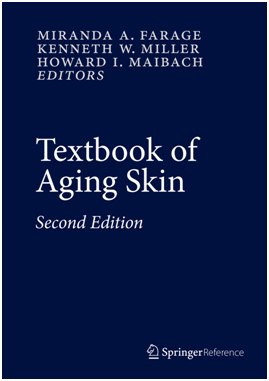
FARAGE, M.; MILLER, K.W.; MAIBACH, H.
Descuento:
-5%Antes:
Despues:
1.481,99 €1. Adipose-Derived Stem Cells and Their Secretory Factors for Skin Aging and Hair Loss.
2. Advanced Age Pruritus.
3. Age-Induced Hair Graying and Oxidative Stress.
4. Age-Related Morphometric Changes of Inner Structures of the Skin.
5. Assessed by In Vivo Reflectance Confocal Microscopy.
6. Age-related changes in skin mechanical properties.
7. Aging Genital Skin and Hormone Replacement Therapy Benefits.
8. Aging and Melanocytes Stimulating Cytokine Expressed by Keratinocyte and Fibroblast.
9. Aging of Epidermal Stem Cells.
10. Appearance and Internal Aging.
11. Basophilic (Actinic) Degeneration of the Dermis: An Easy Histological Scoring Approach in Dermal Photo-Aging.
12. Biology of Stratum Corneum: Tape Stripping and Protein Quantification.
13. Buffering Capacity Considerations in the Elderly.
14. Changes in Nail in the Aged.
15. Changes in the Composition of the Cornified Envelope During Skin Aging: A Calcium Centric Point of View.
16. Cluster of Differentiation 1d (CD1d) and Skin Aging.
17. Considerations for Thermal Injury: The Elderly as a Sensitive Population.
18. Corneocyte Size and Cell Renewal: Effects of Aging and Sex Hormones.
19. Cyanoacrylate Skin Surface Strippings.
20. Degenerative Changes in Aging Skin.
21. Facial Skin Rheology.
22. Histology of Microvascular Aging of Human Skin.
23. Hyaluronan and the Process of Aging in Skin.
24. Impact of Dietary Supplements on Skin Aging.
25. Influence of Exogenous Factors on Skin Aging.
26. Major Changes in Skin Function in the Elderly and Their Contributions to Common Clinical Challenges.
27. Neurotrophins and Skin Aging.
28. Overview of the histology of aging skin in laboratory models.
29. Pathology of Aging Skin.
30. Pathomechanisms of Endogenously Aged Skin.
31. Pathomechanisms of Photoaged Skin.
32. Peroxisome Proliferator-Activated Receptors: Role in Skin Health and Appearance of Photoaged Skin.
33. Physiological Variations During Aging.
34. Platinum and Palladium Nanoparticles Regulate the Redox Balance and Protect Against Age-Related Skin Changes in Mice.
35. Possible Involvement of Basement Membrane Damage by Matrix Metalloproteinases, Serine Proteinases and Heparanase in Skin Aging Process.
36. Proteoglycans in Skin Aging.
37. Skin Aging and Health.
38. Skin Aging: A Brief Summary of Characteristic Changes.
39. Skin Aging: An Immunohistochemical Evaluation.
40. Stratum Corneum Cell Layers.
41. The Extracellular Matrix Protein 1 (ECM1) in Molecular-Based Skin Biology.
42. The Genetics of Skin Aging.
43. The Stratum Corneum and Aging.
44. Unique Skin Immunology of the Lower Female Genital Tract with Age.
45. -Vaginal Secretions with Age.
46. arNOX: A New Source of Aging.
47. arNOX: New Mechanisms of Skin Aging and Lipoprotein Oxidation.
48. Alterations of Energy Metabolism in Cutaneous Aging.
49. Cellular Energy Metabolism and Oxidative Stress.
50. Cutaneous Oxidative Stress and Aging.
51. DNA Damage and Repair in Skin Aging.
52. Fibulin-5 Deposition in Human Skin: Decrease with Aging and UVB Exposure and Increase in Solar Elastosis.- Aging and Intrinsic Aging: Pathogenesis and Manifestations.
53. Biological Effects of Estrogen on Skin.
54. Climate Change and its Dermatologic Impact on Aging Skin.
55. Cutaneous Responses to Tropospheric Ozone Exposure.
56. DNA Biomarkers in Aging Skin.
57. Environmental and Genetic Factors in Facial Aging in Twins.
58. Infrared A-Induced Skin Aging.- Infrared Radiation: Mechanisms, Implications, and Protection.
59. Perimenopausal Aging and Oral Hormone Replacement Therapy.
60. Sebum Production.
61. Skin Photodamage Prevention: State of the Art and New Prospects.
62. -Tobacco Smoke and Skin Aging*.
63. Aging skin as a diagnostic tool for internal diseases: A chance for dermatology.
64. Aging-Associated Non-Melanoma Skin Cancer: A Role for the Dermis.
65. Atopic Dermatitis in the Aged.
66. Carcinogenesis: UV Radiation.
67. Control of Skin Blood Flow.
68. Cutaneous Effects and Sensitive Skin with Incontinence in the Aged.
69. Dry Skin in Diabetes Mellitus and in Experimental Models of Diabetes.
70. Facial Wrinkling
This comprehensive book presents the latest information on all aspects of the aging skin, including a broad spectrum of the relevant basic science, malignant and non-malignant age-associated diseases and conditions, techniques and methods, toxicological and safety considerations in the elderly, psychological and social issues, ethnicity and gender differences and marketing to the aged. Since the first edition the book has been extensively updated and revised, with the inclusion of many additional chapters that describe the most recent advances in scientific, medical and technical understanding of the aging phenomenon. There is, for example, extended coverage of physiology, description of novel bioengineering methods and tools, detailed consideration of developments in genomics research, and information on new ingredients and products. Textbook of Aging Skin is written by global experts and thought leaders and is intended to serve as the single and complete reference on the subject. It will be of value for dermatologists, gerontologists, toxicologists, biologists and a range of other professionals.
Features
• Describes recent advances in scientific, medical and technical understanding of the aging skin
• Covers all aspects, from basic science to diseases, techniques, toxicology, and psychosocial issues
• Explores global perspectives, including perception, needs and responses to skin aging
• Brings the reader up to date with many completely new chapters
Authors
• Miranda A. Farage is a Principal Scientist in Feminine Care and Family Care Clinical Sciences at the Procter & Gamble Company. Dr. Farage leads research on vulvology, dermatological testing, methods development, sensitivity, physiology, and general vulva health. She has published more than one hundred manuscripts in peer-reviewed journals and has co-authored several scientific textbooks in women’s health and dermatoxicology. She received a Ph.D. in toxicology/pharmacology at the University of Illinois, Urbana-Champaign. Before joining Procter & Gamble, she was a faculty member at Virginia Tech University.
• Dr. Kenneth Miller is the Associate Director for Global Product Safety, Regulatory and Microbiology in for the Feminine Care and Family Care business units at The Procter and Gamble Company. Dr. Miller is responsible for the strategic development and execution of research and testing in the areas of dermatoxicology, clinical safety and efficacy studies, post-market surveillance studies, epidemiology studies, environmental studies (biodegradation, solid waste disposal, aquatic and terrestrial toxicology and global waste disposal infrastructure), standard microbiological testing and microbiological methods development research (including molecular microbiology techniques). Too, he has responsibility for a team conducting microbiological and clinical research in toxic shock syndrome, superantigens, and vaginal microbial ecology. Dr. Miller has published over twenty-five manuscripts in the area of toxicology in peer-reviewed journals plus numerous abstracts and presentations at meetings of scientific societies. Dr. Miller is board-certified in toxicology (DABT) and a member of several scientific and professional societies.
• Howard I. Maibach is Professor of Dermatology at the University of California at San Francisco School of Medicine. The author of over 1700 papers in dermatology, toxicology, pharmacology, physiology and related fields, he is the co-editor of several books including Cosmeceuticals; Cutaneous Infection and Therapy; Cutaneous Infestations and Insect Bites; Neonatal Skin; Percutaneous Absorption, Third Edition; and Psoriasis, Third Edition. He received his M.D. from Tulane University.
 -5%
-5%
 -5%
-5%
 -5%
-5%
 -5%
-5%
 -5%
-5%
 -5%
-5%
 -5%
-5%
 -5%
-5%
 -5%
-5%
 -5%
-5%
 -5%
-5%