Descuento:
-5%Antes:
Despues:
60,27 €CHAPTER 1 BEGINNINGS
Some ancient intuitions
Spontaneous generation
Vitalism
The demise of vitalism
The rise of modern biology
The microscope opens a new world
CHAPTER 2 THE ORIGINS OF BIOCHEMISTRY
Recognition of proteins
Some proteins are catalysts: Enzymes
What enzymes do, and why it is so important
How do enzymes work?
Proteins fulfill many roles
What are proteins made of?
CHAPTER 3 THE CHEMICAL STRUCTURE OF PROTEINS
The peptide hypothesis
Colloid or macromolecule?
Some unexpected results
Proteins as homogeneous polypeptides
Fred Sanger and the sequence of insulin
Boxes:
Box.3.1 Separation Methods
A: Sedimentation
B: Chromatography
C: Electrophoresis
Box 3.2 Immunological methods
CHAPTER 4 PROTEINS IN THREE DIMENSIONS
Fibers
Globules
The first globular protein structures
Boxes:
Box 4.1 How to Determine Protein Structure
A. The principle of diffraction
B. Diffraction from fibers
C. Diffraction from crystals
CHAPTER 5 THE ORIGINS OF GENETICS
Classical genetics and the rules of trait inheritance
Friar Gregor Mendel plants some peas
Mendel formulates the two laws of inheritance
Mendel’s laws have extensions and exceptions
Mendel was long ignored
Darwin, Mendelism, and mutations
Genes are arranged linearly on chromosomes and can be mapped
What do genes do, and what are they made of?
CHAPTER 6 NUCLEIC ACIDS
Miescher's mysteries
The chemical structures of nucleic acids
“What is life?”
DNA carries genetic information
Mysterious numbers
Boxes:
Box 6.1 Gel electrophoresis
CHAPTER 7 THE GREAT SYNTHESIS
Bacteria and viruses have genetics, too: the introduction of cloning
Critical experiments show that the genetic material is DNA
Revealing DNA structure; perspiration plus inspiration
"It has not escaped our attention..."
The most beautiful experiment
DNA sequence and protein sequence; a tale of two languages
Methods Box: Reading a helix and chasing replication
CHAPTER 8 HOW DNA IS REPLICATED
What is the mode of replication?
How does replication proceed?
The lagging strand problem
CHAPTER 9 THE CENTRAL DOGMA
Speaking in different languages
Intuiting a dogma
Who is the Messenger?
The great decade: 1952-1962
CHAPTER 10 THE GENETIC CODE
How might a code function?
What kind of code?
What were the code words?
The code
CHAPTER 11 GENE TO PROTEIN: THE WHOLE PATH
What was known in 1960?
Breakthrough
The rest of the story
Regulation of transcription in bacteria
Overview
CHAPTER 12 EUKARYOTES POSE NEW PROBLEMS
What is a eukaryote?
The origin of eukaryotes
The three domains of life
Interrupted messages and splicing
Every cell type has special needs and functions
Multiple levels of control
Chromatin and nucleosomes
Too much DNA? Junk DNA?
CHAPTER 13 DIFFERENTIATION AND DEVELOPMENT
Two Ideas about development dominated thinking in ancient times
The Introduction of scientific approaches to the field of development
An opportunity missed?
What do we know about development and differentiation at present?
Embryonic stem cells (ESC) serve as a model for pluripotency
The Molecular Basis of Differentiation and Development
The maternal-zygotic transition
Genes control development: the case for the fruit fly
Nuclear transfer experiments and the principle of genetic equivalence
Genome reprogramming towards earlier phases of development is possible
CHAPTER 14 RECOMBINANT DNA: THE NEXT REVOLUTION
The power of DNA recombination
How to clone DNA
Construction of recombinant DNA molecules needs restriction endonucleases and ligases
The first recombinant DNA molecules
Polymerase chain reaction and site-directed mutagenesis
Manipulating the genetic content of eukaryotic organisms
CRISPR, the gene-editing technology of today and tomorrow
Boxes:
Box 12.1: Cloning vectors. The expression of recombinant genes.
CHAPTER 15 UNDERSTANDING WHOLE GENOMES: CREATING NEW PARADIGMS
The evolution of sequencing methodology
Genomic libraries contain the entire genome of an organism as a collection of recombinant DNA molecules
There are two classic approaches for sequencing large genomes
Ultrafast sequencing allows deep analysis of genomes
Whole genomes
The human genome project
ENCODE results raise question. Whence biology?
So, what was learned from ENCODE?
Transcription factors interact in a huge network
Where is ENCODE leading?
Attempts at a contemporary definition of a gene
Boxes:
Box 15.1 The classic definition of a gene is not consistent with recent observations
CHAPTER 16 WHOLE GENOMES AND EVOLUTION
Evolutionary theory: from Darwin to the present day
Classifying organisms: Phylogenetics
Phylogenetics goes molecular
The comparative genomics revolution
Tracing human evolution
CHAPTER 17 PRACTICAL APPLICATIONS OF RECOMBINANT DNA TECHNOLOGIES
Catching criminals and freeing the innocent
Production of pharmaceutical compounds in recombinant bacteria or yeast
Genetic engineering of plants
Gene therapy
A CRISPR revolution?
Cloning of whole animals
Jurassic park or de-extinction
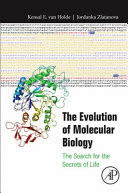
• Expands on the development of molecular biology from the convergence of two independent disciplines, biochemistry and genetics
• Discusses the value of molecular biology in a variety of applications
• Includes research ethics and the societal implications of research
• Emphasizes the human aspects of research and the consequences of such advances to society
Authors
• Kensal Van Holde, Oregon State University, Department of Biochemistry and Biophysics.
• Jordanka Zlatanova, University of Wyoming, Department of Molecular Biology
 -5%
-5%
 -5%
-5%
 -5%
-5%
 -5%
-5%
 -5%
-5%
 -5%
-5%
 -5%
-5%
 -5%
-5%
 -5%
-5%
 -5%
-5%