Descuento:
-5%Antes:
Despues:
167,96 €1. The Fractal Geometry of the Brain: An Overview
2. Box-Counting Fractal Analysis: A Primer for the Clinician
3. Tenets and Methods of Fractal Analysis (1/
4. Tenets, Methods, and Applications of Multifractal Analysis in Neurosciences
5. Fractals in Neuroanatomy and Basic Neurosciences: An Overview
6. Morphology and Fractal-Based Classifications of Neurons and Microglia
7. The Morphology of the Brain Neurons: Box-Counting Method in Quantitative Analysis of 2D Image
8. Neuronal Fractal Dynamics
9. Does a Self-Similarity Logic Shape the Organization of the Nervous System?
10. Fractality of Cranial Sutures
11. The Fractal Geometry of the Human Brain: An Evolutionary Perspective
12. Fractal Analysis in Clinical Neurosciences: An Overview
13. Fractal Analysis in Neurological Diseases
14. Fractal Dimension Studies of the Brain Shape in Aging and Neurodegenerative Diseases
15. Fractal Analysis in Neurodegenerative Diseases
16. Fractal Analysis of the Cerebrovascular System Physiopathology
17. Fractals and Chaos in the Hemodynamics of Intracranial Aneurysms
18. Fractal-Based Analysis of Arteriovenous Malformations (AVMs)
19. Fractals in Neuroimaging
20. Computational Fractal-Based Analysis of MR Susceptibility-Weighted Imaging (SWI) in Neuro-oncology and Neurotraumatology
21. Texture Estimation for Abnormal Tissue Segmentation in Brain MRI
22. Tumor Growth in the Brain: Complexity and Fractality
23. Histological Fractal-Based Classification of Brain Tumors
24. Computational Fractal-Based Analysis of Brain Tumor Microvascular Networks
25. Fractal Analysis of Electroencephalographic Time Series (EEG Signals)
26. On Multiscaling of Parkinsonian Rest Tremor Signals and Their Classification
27. Fractals and Electromyograms
28. Fractal Analysis in Neuro-ophthalmology
29. Fractals in Affective and Anxiety Disorders
30. Fractal Fluency: An Intimate Relationship Between the Brain and Processing of Fractal Stimuli
31. Computational Fractal-Based Neurosciences: An Overview
32. Fractal Analysis in MATLAB: A Tutorial for Neuroscientists
33. Methodology to Increase the Computational Speed to Obtain the Fractal Dimension Using GPU Programming
34. Fractal Electronics as a Generic Interface to Neurons
35. Fractal Geometry Meets Computational Intelligence: Future Perspectives
36. Erratum to: The Fractal Geometry of the Brain
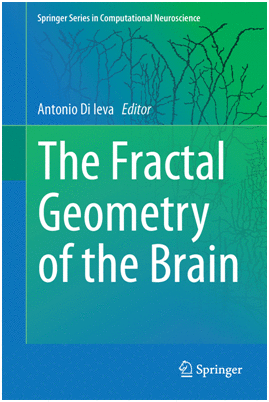
Reviews the most intriguing applications of fractal analysis in neuroscience with a focus on current and future potential, limits, advantages, and disadvantages. Will bring an understanding of fractals to clinicians and researchers also if they do not have a mathematical background, and will serve as a good tool for teaching the translational applications of computational models to students and scholars of different disciplines. This comprehensive collection is organized in four parts: (1) Basics of fractal analysis; (2) Applications of fractals to the basic neurosciences; (3) Applications of fractals to the clinical neurosciences; (4) Analysis software, modeling and methodology.
Features
• Provides a thorough overview of fractal analysis that is accessible to clinicians and non-mathematicians
• Only book to provide information on fractal analysis specifically for the neurosciences
• Provides information on webpages and software that can be used for fractal analysis
 -5%
-5%
 -5%
-5%
 -5%
-5%
 -5%
-5%
 -5%
-5%
 -5%
-5%
 -5%
-5%
 -5%
-5%
 -5%
-5%
 -5%
-5%