Descuento:
-5%Antes:
Despues:
131,10 ۥ PART I: INTRODUCTION TO ECONOMICS AND HUMAN BIOLOGY
Introduction
1. Growth Faltering in the First Thousand Days after Conception and Catch-up Growth
2. Biological Measures of Well-Being
3. Crisis and Human Biology
4. The biological standard of living in Europe from the Late Iron Age to the Little Ice Age
5. Econometrics of Economics and Human Biology
• PART II: BIOLOGICAL MEASURES AS AN OUTCOME
6. Body Mass Index Through Time
7. Health, body weight, and obesity
8. Inequality and Heights
9. Adult Weight and Height of Native Populations
10. Slave Heights
11. Female Heights and Economic Development: Theory and Practice
12. The Impact of Socioeconomic Inequality On Children's Health and Wellbeing
13. Growth and Maturation of Children and Adolescents: Variability Due to Genetic and Environmental Factors
14. Global Perspectives on Economics and Biology
15. Global BMI Trends
16. Poverty and Obesity in Developed Countries
• PART III: BIOLOGICAL MEASURES AS AN INPUT TO MONETARY OUTCOMES, PRODUCTIVITY, AND WELFARE
17. Biomarkers as Inputs
18. How Genetics Can Inform Health Economics
19. Twins Studies in Economics
20. Public and Private Returns to Investing in Nutrition
21. The Double Burden of Malnutrition
22. Biological health risks and economic development
23. Obesity and Income Inequality in OECD Countries
24. Height and Wages
25. Why do people with higher body weight earn lower wages?
26. Wealth and Weight
27. Family Economics and Obesity
28. Obesity and Welfare Regimes
29. Children's Anthropometrics and Later Disease Incidence
30. Birth Weight as an Indicator of Human Welfare
31. A Pound of Flesh: birth weight as a measure of endowment in economics research
32. Neuroeconomics: A Flourishing Field
• PART IV: REGIONAL STUDIES
33. The African Enigma: The Mystery of Tall African Adults Despite Low Incomes
34. East Asia on the Rise: The Anthropometric History of China, Japan, and Korea
35. Economics and Human Biology in Latin America
36. Racial Differences in Health in the USA: A Long-Run Perspective
37. Antebellum Puzzle: The Decline in Heights at the Onset of Modern Economic Growth
38. The Anthropometric History of the Mediterranean World
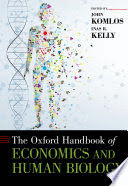
The Oxford Handbook of Economics and Human Biology provides an extensive and insightful overview of how economic conditions affect human well-being and how human health influences economic outcomes. Among the topics explored are how variations in height, whether over time, among different socio-economic groups, and in different locations, are important indicators of changes in economic growth and economic development, levels of economic inequality, and economic opportunities for individuals. The book covers a broad geographic range: Africa, Latin and North America, Asia, and Europe. Its temporal scope ranges from the late Iron Age to the present. Taking advantage of recent improvements in data and economic methods, the book also explores how humans' biological conditions influence and are influenced by their economic circumstances, including poverty. Among the issues addressed are how height, body mass index (BMI), and obesity can affect and are affected by productivity, wages, and wealth. How family environment affects health and well-being is examined, as is the importance of both pre-birth and early childhood conditions for subsequent economic outcomes. Reflecting this dynamic and expanding area of research, the volume shows that well-being is a salient aspect of economics, and the new toolkit of evidence from biological living standards enhances understanding of industrialization, commercialization, income distribution, the organization of health care, social status, and the redistributive state affect such human attributes as physical stature, weight, and the obesity epidemic in historical and contemporary populations.
Features
• First overview of innovative and growing field
• Comprehensive coverage of insights gained from cross-disciplinary research
• Accessible syntheses of findings on history, social dynamics, and such important issues as income inequality
• Contributors are leading scholars from economics and other disciplines
Authors
• Dr. John Komlos, Professor Emeritus, University of Munich and Duke University.
• Dr. Inas Kelly, Associate Professor of Economics, Queens College of the City University of New York
 -5%
-5%
 -5%
-5%
 -5%
-5%
 -5%
-5%
 -5%
-5%
 -5%
-5%
 -5%
-5%
 -5%
-5%
 -5%
-5%
 -5%
-5%