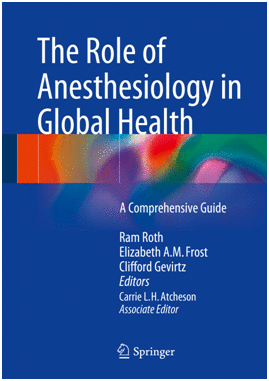
ROTH, R.; FROST, E.; GEVIRTZ, C.; ATCHESON, C.
Descuento:
-5%Antes:
Despues:
98,79 €This is a comprehensive guide to the role of anesthesiologists in medical missions. In their capacity as perioperative physicians, anesthesiologists improve the safety and efficacy of surgical interventions for underserved patients in low- and middle-income countries around the world. Contributions from international experts in global health provide essential historical context, practical medical and surgical considerations for planning missions, and scenarios of “on the ground” implementation of care. The final section considers anesthesiology education in the context of global health. This is an encompassing and eye-opening resource for trainees and physicians considering participating in a medical mission and students and faculty of global health.
“This brilliantly assembled expert compendium provides a much-needed guide for the practical application of anesthesiology in medical practice in the most bereft underdeveloped and violence-afflicted regions of the globe.” —Seymour Topping, Professor Emeritus of International Journalism, Columbia University
Features
- First comprehensive guide to the role of the anesthesiologist in global health
- Specific surgical diseases endemic to low- and middle-income countries covered
- Management of acute and chronic traumatic injuries in a low-resource setting detailed
- Real-life clinical scenarios illustrate that more can be done with less
- Underscores need for collaborative development of global health strategy.
Authors
- Ram Roth, MD Assistant Professor, Department of Anesthesiology, Icahn School of Medicine at Mount Sinai, New York, New York USA; Attending, Department of Anesthesiology, Mount Sinai Hospital of Queens, Queens, New York USA.
- Clifford Gevirtz, MD Adjunct Associate Professor of Anesthesiology, Louisiana State University, School of Medicine, New Orleans, LA USA.
- Carrie Atcheson, MD, MPH PGY-4, Department of Anesthesiology, Icahn School of Medicine at Mount Sinai, New York, New York USA.
- Elizabeth Frost, MD Professor of Anesthesiology, Icahn Medical Center at Mount Sinai, New York, NY USA.
Table of contents (29 chapters)
1.Medical Missions: A Short History from There to Here
2.The Evolution of Surgical Humanitarian Missions
3.The Global Burden of Surgical Need
4.Anesthesia Disparities Between High-Income Countries and Low-and Middle-Income Countries: Providers, Training, Equipment, and Techniques
5.Planning a Mission, Fundraising, and Building a Team
6.Developing Anesthesia Equipment for Low-Resource Environments
7.Materials Management and Pollution Prevention
8.What Do Patients and Communities Expect of a Medical Mission?
9.Anesthesia in Resource-Poor Settings: The Médecins Sans Frontières Experience
10.Quality of Care: Maintaining Safety Through Minimum Standards
11.Legal and Ethical Issues in Global Health: A Trip Through the Vagaries of Truth and Culture
12.Strategies for Patient Assessment and Scheduling
13.Perioperative Follow-Up and Quality Maintenance
14.Women’s Rights to Pain Relief After Surgery and Labor Analgesia
15.Saving Sight in Developing Countries
16.Cardiothoracic Anesthesia and Intensive Care: What Is the Role of Missions?
17.Anesthesia Considerations for Facial Deformity Repair in Lesser Developed Countries
18.A Regional Anesthesia Service in a Resource-Limited International Setting: Rwanda
19.Management of Pain in Less Developed Countries
20.Living the Mission in Serbia and Other Less Affluent Worlds
21.Anesthetic Management During the Lebanese Civil War
22.Trauma, War, and Managing Vascular and Orthopedic Injuries
23.Anesthesiologists’ Role in Disaster Management
24.Surgical Mission Trips as a Component of Medical Education and Residency Training
25.Building a Global Health Education Program in an Urban School of Medicine
26.Closing the Gap in Europe Through Education: A Reverse Mission
27.The Role of the Visiting Anesthesiologist in In-Country Education
28.Letters from Around the World
29.The Future of Anesthesiology and Global Health in a Connected World
 -5%
-5%
 -5%
-5%
 -5%
-5%
 -5%
-5%
 -5%
-5%
 -5%
-5%
 -5%
-5%
 -5%
-5%
 -5%
-5%
 -5%
-5%