Descuento:
-5%Antes:
Despues:
109,25 €Scientific and Moral Philosophy pp.1-2
1. The Karl Popper Memorial Lecture pp.3-10
2. Plato’s Socratic Dialogues and the Epistemology of Modern Medicine pp.11-20
3. Justice pp.21-24
4. The Role of the Learned Societies in Improving Quality of Life in the Context of Globalization pp.25-34
5. Ethical Issues in Screening for Cancer pp.35-38
6. The Use and Abuse of Human Tissue: An Analysis of the Ethical Issues Raised by the Proposed Human Tissue Act pp.39-44
7. Playing God – Jewish Perspectives on Cloning and Genetic Engineering pp.45-48
Medical Humanities pp. 49-50
8. The Re-Emerging role of the Humanities in the Education of Medical Undergraduates pp.51-70
9. Evidence Based Art? pp.71-74
10. Book Review for JRoyal Soc Med pp.75-80
11. The Art of Oncology: The Changing Faces of Breast Cancer Treatment pp.81-92
Alternative Medicine pp.93-94
12. An Open Letter to His Royal Highness the Prince of Wales: With Respect Your Highness You’ve Got it Wrong pp.95-98
13. Book review “Whole Person Care: A New Paradigm for the 21st Century” pp.99-104
14. Concepts of Holism in Orthodox and Alternative Medicine pp.105-112
15. Complementary and Alternative Medicine (CAM) within the National Health Service pp.113-116
16. Can We Sustain an Open-Minded Approach to Homeopathy? pp.117-120
17. Homeopathy Waives the Rules-OK? pp.121-128
18. Magic Mushrooms and Bent Spoons: That Was the Week that Was? pp.129-132
19. The Scam of Integrative Medicine pp.133-136
20. An Unusual Opportunity to Study the “Natural History” of Breast Cancer p.137-138
21. A Letter to the Editor Declining a Book Review for Focus on Alternative and Complementary Therapy (FACT) pp.139-140
Cancer in General pp.141-142
22. What are the Needs of Patients Diagnosed with Cancer? pp.143-146
23. Scientific Method and the Search for the Cure for Cancer pp.147-152
24. Prevention is Better than Cure! I Wouldn’t Be so Sure Mr. Brown pp.153-160
25. Book Review for Spiked: The Secret War on Cancer, by Devra Davis pp.161-166
Breast Cancer pp.167-168
26. Breast Cancer: A Personal Prologue pp.169-174
27. The Natural History of Breast Cancer pp.175-194
28. Breast Cancer Awareness As a Prerequisite for Reducing Mortality in Resource Poor Parts of the World pp.195-196
29. Surgery for Breast Cancer: Shifting Paradigms and Scientific Revolutions pp.197-202
30. The Golden Ibex of Santorini: A Convergence of Cultures and Technologies pp.203-206
31. Intra-Operative Partial Breast Irradiation after Breast Conserving Surgery: The History and Outcomes of the TARGIT Trial May 2014 pp.207-224
32. The Historical and Cultural Determinants in the Evolution of Adjuvant Endocrine Therapy: Two Hemispheres Separated By a Common Language pp.225-230
33. A Tyranny of Cheerfulness: Pink Ribbons at the Human Rights Watch Film Festival 29th March 2012 pp.231-234
Screening for Breast Cancer pp.235-240
34. Breast Cancer Awareness month: “Black October” pp.241-246
35. The Illusions and Delusions of Screening for Cancer pp.247-258
36. Cancer “Tsar” Announces Independent Review of Screening for Breast Cancer pp.259-262
37. The Marmot Report: Accepting the Poisoned Chalice pp.263-266
38. To Screen or Not to Screen: Daily Mail pp.267-270
39. Breaking News pp.271-272
Towards Synthesis pp.273-274
40. “2084”: A Play in Three Acts (With acknowledgments to George Orwell)pp.275-290
41. My Thoughts on the Fifth Anniversary of 9/11 pp.291-292
42. Pre-Implantation Genetic Diagnosis: The Spectre of Eugenics or a “No Brainer” pp.293-296
43. Book Review: The Archaeology of Race by Debbie Challis pp.297-304
44. Back to the Future pp.305-310
45. Valedictory Editorial for the International Journal of Surgery pp.311-314
46. The Meaning of Life and Other Easy Questions pp.315-326
47. Why Me? pp.327-328
Acknowledgements pp.329-330
Index pp.333-352
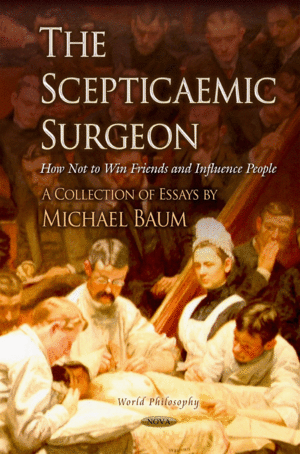
Michel de Montaigne invented the literary term “essay” derived from the French word essai, meaning to put on trial. In his collection of essays he describes his life’s work in testing his responses to different subjects and situations, using his ego and alter ego as council for and against the case. In one such essay he writes, “Why do doctors begin by practising on the credulity of their patients with so many false promises of a cure, if not to call the powers of the imagination to the aid of their fraudulent concoctions?” It is hard to believe that this was written over 400 years ago, yet this book of essays in the style invented by Montaigne, is still addressing the same follies ascribed to 16th Century French citizens.
In 1764 Voltaire published his Dictionnaire philosophique in which he took the essay format one step further by adding his sardonic wit, to better illuminate the follies and fallacies of that époque.
One of his aphorisms that resonates 250 years on, went like this: “Faith consists in believing when it is beyond the power of reason to believe. It is not enough that a thing be possible for it to be believed”.
Thomas Browne, an English essayist of the same period attempted to understand the follies of mankind and their capacity of making “vulgar errors” in observation and belief. One was entitled “That a man hath one Rib less than a woman”. Christian orthodoxy of the day taught a fundamentalist interpretation of the Bible. It therefore followed that if Eve were fashioned from Adam’s rib, then Eve’s descendents would always have one more rib than Adam’s descendents. Browne doubted that and went to study anatomy in the Low Countries and made his business to count the number of ribs on both sides of the chest in male and female cadavers.
In this collection of essays Michael Baum follows in the footsteps of these giants of the Enlightenment a provides with a selection of his essays written over a period of more than 20 years where he challenges much of the received wisdom of the current era. Building on a foundation of scientific and moral philosophy he then carries out a hatchet job on the proponents of quackery. His scepticism then carries over in attacks on the closed minds of those who inhibit innovation and those who are stuck in the time warp of the uncritical acceptance of screening for cancer. Throughout this book it can be seen that he is guided by the teachings of medical humanities. In 1989 Dr.Petr Skrabanek published a book entitled “Follies and Fallacies in Medicine” continuing the tradition of the age of enlightenment where, for the first time, the pathological state of scepticaemia is defined as follows.
Scepticaemia: An uncommon generalized disorder of low infectivity. Medical school education is likely to confer life-long immunity.
Author
A Collection of Essays by Michael Baum (Professor Emeritus of Surgery & Visiting Professor in Medical Humanities, University College London, UK)
 -5%
-5%
 -5%
-5%
 -5%
-5%
 -5%
-5%
 -5%
-5%
 -5%
-5%
 -5%
-5%
 -5%
-5%
 -5%
-5%
 -5%
-5%